A Global Campus with a Local Heart: Marwadi University is Transforming the Indian Education Map
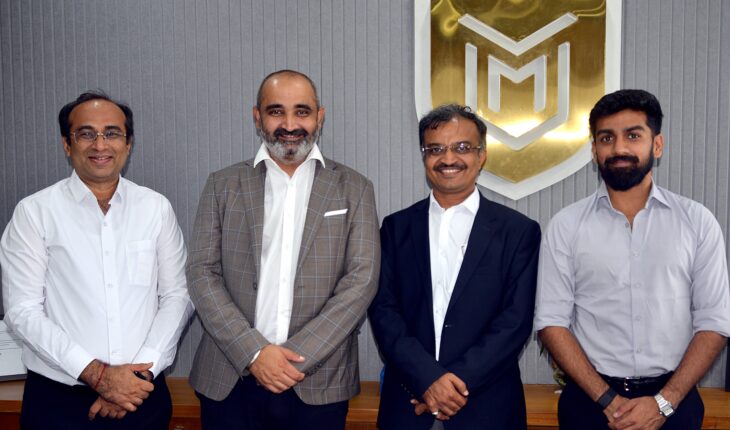
Rajkot (Gujrat): In the heart of Saurashtra, far from the usual academic powerhouses, Marwadi University in Rajkot is rewriting the script of Indian higher education—not by replicating global trends, but by reinventing them with purpose, precision, and people-first innovation.
During a recent two-day visit, a delegation of journalists from Bengaluru witnessed not just the brick-and-mortar of a university campus, but the beating heart of a movement. Founded in 2008 and granted university status in 2016, Marwadi University emerged from a deeply personal struggle: its founders’ own battles with access to higher education. Today, their journey has grown from a modest cohort of 300 to an international academic community of over 15,000 students—including 1,700 from 54 countries—and it’s just getting started.
At the core of its Vision 2027 is an audacious promise: to grow to 25,000 students, break into QS global rankings, and enter India’s NIRF Top 100—all while retaining academic intimacy and inclusivity. “We were born to break barriers,” said Trustee Dhruv Marwadi. “Scale is our goal, but never at the cost of soul.”
What makes Marwadi’s approach revolutionary is its deep investment in personalized attention at scale. Using its proprietary digital ERP system, the university tracks every student’s learning curve—monitoring attendance, library engagement, and even soft skills like critical thinking and public speaking. Underperformers aren’t left behind—they’re flagged and mentored, not just academically, but emotionally and financially. “No one slips through the cracks,” said Pro Vice Chancellor Dr. Sanjeet Singh. “We lift the average, not just the exceptional.”
Faculty at Marwadi are not just educators—they are trained mentors, each guiding 15 students through a digitized mentoring system. With 758 full-time and 100 adjunct faculty from 12 countries, all PhD-holders or pursuing doctorates, teaching here is both an art and a science. The university’s Teaching-Learning Center (TLC) ensures that content delivery is modern, inclusive, and continuously evolving.
Research is another pillar. With ₹20 crore invested in cutting-edge infrastructure and 1,500+ annual publications—many co-authored by students—the university is driving applied innovation. The Marwadi University Research Center is a bustling think tank where undergraduates, doctoral candidates, and international researchers collaborate on frontier topics, from AI to forced migration.
A standout example is its EU-funded Master’s in Forced Migration, co-developed with institutions in Greece, Vietnam, Italy, and Australia. One of its PhD leads is a Syrian scholar whose own displacement story shapes the curriculum. “Education must mirror lived realities,” said Singh. “Only then can we solve real-world problems.”
The university’s international footprint is rapidly expanding. With over 45 global partnerships—including with Webster University (USA), Bloomsbury Institute (UK), and Cattolica University (Italy)—students participate in exchange programs, dual degrees, and paid internships abroad. Unlike many academic MoUs that gather dust, Marwadi’s collaborations are impact-driven. “Every tie-up is measured by its ROI—for the student, not the institution,” Singh emphasized.
Even domestically, Marwadi University is turning heads. Collaborations with Nvidia, MG Hector, and Volvo are already operational, and a ₹60 crore innovation lab with Bajaj is in the pipeline. The campus itself has become a multicultural crucible—where an Afghan student, a Malayali peer, and a British professor may co-create a robotics project, all within a Rajkot lab.
Executive Registrar Naresh Jadeja summed it up: “Our mandate is simple. Create a system where excellence is democratic, not elitist. Where global exposure is standard, not privilege.”
Marwadi University is not just chasing rankings. It is chasing relevance—with heart, hustle, and a hunger to transform how education is imagined in emerging India. In doing so, it has become more than a university. It is a prototype for what higher education should be: accessible, inclusive, global—and deeply, unapologetically human.