Agentic AI in Cybersecurity: The Complete Student Guide to Future Careers and Skills
Cybersecurity is changing faster than ever before, and Artificial Intelligence (AI) is leading this transformation. One of the newest developments is Agentic AI in Cybersecurity, where AI systems can make decisions, perform tasks, and respond to cyber threats with minimal human intervention. Unlike traditional AI tools that wait for instructions, Agentic AI can plan, adapt, and act on its own to solve complex security challenges.
As cyberattacks become more advanced, organizations need intelligent systems that can detect threats, investigate incidents, and respond in real time. This is creating exciting opportunities for students interested in AI in Cybersecurity and opening doors to a new generation of Cybersecurity Careers.
Whether you are pursuing Computer Science, Information Technology, or Cybersecurity, understanding Agentic AI will give you a competitive advantage in the job market. Employers are already looking for graduates who understand AI-driven security tools, automation, cloud security, and ethical hacking.
Marwadi University is recognized among the leading institutions for engineering and technology education in India. Its Computer Science subject is ranked among the Top 40 in QS Asia Subject Rankings, reflecting its global academic excellence. The university offers NBA Tier-1 accredited programs, holds an NAAC A+ accreditation, and is ranked in the Top 200–300 engineering institutions in India by NIRF. Adding to its achievements, Marwadi University has also been recognized as a Centre of Excellence by the Government of Gujarat, highlighting its commitment to quality education, innovation, and industry-focused learning.
In this blog, you’ll learn what Agentic AI is, how attackers and defenders are using it, the future career opportunities it creates, the Cybersecurity Skills 2026 employers are looking for, and how Marwadi University prepares students for this exciting future.
What is Agentic AI?
Artificial Intelligence has evolved significantly over the past few years. Traditional AI systems are designed to perform specific tasks based on human instructions. They can analyze data, recognize patterns, or answer questions, but they usually require constant human guidance.
Agentic AI is different.
Agentic AI refers to intelligent systems that can independently plan, make decisions, learn from situations, and complete multiple tasks to achieve a goal. Instead of simply following commands, these AI agents understand objectives and decide the best way to accomplish them.
In Agentic AI in Cybersecurity, these intelligent agents continuously monitor networks, identify suspicious activities, investigate security incidents, and recommend or even perform appropriate responses without waiting for human intervention.
For example, if unusual login activity is detected, an AI agent can automatically verify user behavior, block unauthorized access, alert security teams, and begin an investigation, all within seconds.
This level of intelligence helps organizations respond to threats much faster than traditional security systems. As cyber threats continue to grow, businesses worldwide are investing in AI-Powered Cybersecurity solutions that improve speed, accuracy, and efficiency.
For students, understanding Agentic AI means preparing for the future of digital security, where humans and intelligent machines work together to protect organizations.
How Hackers Are Using AI Agents
As cybersecurity professionals adopt AI to strengthen security, cybercriminals are also using it to make their attacks more sophisticated and difficult to detect. AI enables hackers to automate tasks, scale attacks, and exploit vulnerabilities faster than ever before.
Some of the common ways hackers are using AI agents include:
- Creating AI-generated phishing emails: AI can generate highly personalized and convincing phishing emails that closely resemble messages from trusted organizations, making it easier to trick users into revealing sensitive information.
- Scanning for system vulnerabilities: AI agents can scan thousands of networks and applications within minutes to identify security weaknesses and prioritize the easiest targets.
- Developing AI-powered malware: Modern malware can adapt its behavior, modify its code, and evade traditional antivirus software, making it much harder to detect and remove.
- Automating password attacks: AI helps cybercriminals perform faster and more efficient password guessing and credential-stuffing attacks using leaked login data.
- Enhancing social engineering attacks: Hackers use AI to create realistic fake voices, deepfake videos, and convincing websites that increase the success rate of scams and impersonation attacks.
These evolving threats highlight the importance of staying updated with the latest cybersecurity practices. By understanding how attackers use AI, future cybersecurity professionals can build stronger defenses and better protect digital systems.
How Defenders Use AI Agents
While hackers are using AI to launch smarter attacks, cybersecurity professionals are using Agentic AI in Cybersecurity to strengthen digital defenses and respond to threats more efficiently. AI agents act as intelligent assistants, helping security teams detect, investigate, and respond to cyber incidents in real time.
Here are some of the key ways defenders use AI agents:
- 24/7 security monitoring: AI agents continuously monitor networks, devices, and user activities to detect unusual behavior without human intervention.
- Supporting Security Operations Centers (SOC): In a Security Operations Center (SOC), AI helps analysts filter millions of security alerts, reduce false positives, and focus on genuine threats.
- Autonomous Threat Detection: AI agents can identify suspicious activities, analyze attack patterns, and investigate potential threats automatically, enabling faster and more accurate decision-making.
- Incident Response Automation: When malware or ransomware is detected, AI can isolate infected systems, block malicious traffic, collect evidence, and alert security teams within seconds, minimizing potential damage.
- Predicting future cyber threats: By analyzing historical attack data and identifying hidden patterns, AI helps organizations anticipate future attacks and improve their overall security posture.
Rather than replacing cybersecurity professionals, Agentic AI enhances their capabilities by automating repetitive tasks and allowing experts to focus on complex investigations, strategic planning, and proactive threat management.
Careers That Will Emerge
The rapid adoption of Agentic AI is creating exciting career opportunities for students interested in cybersecurity and artificial intelligence.
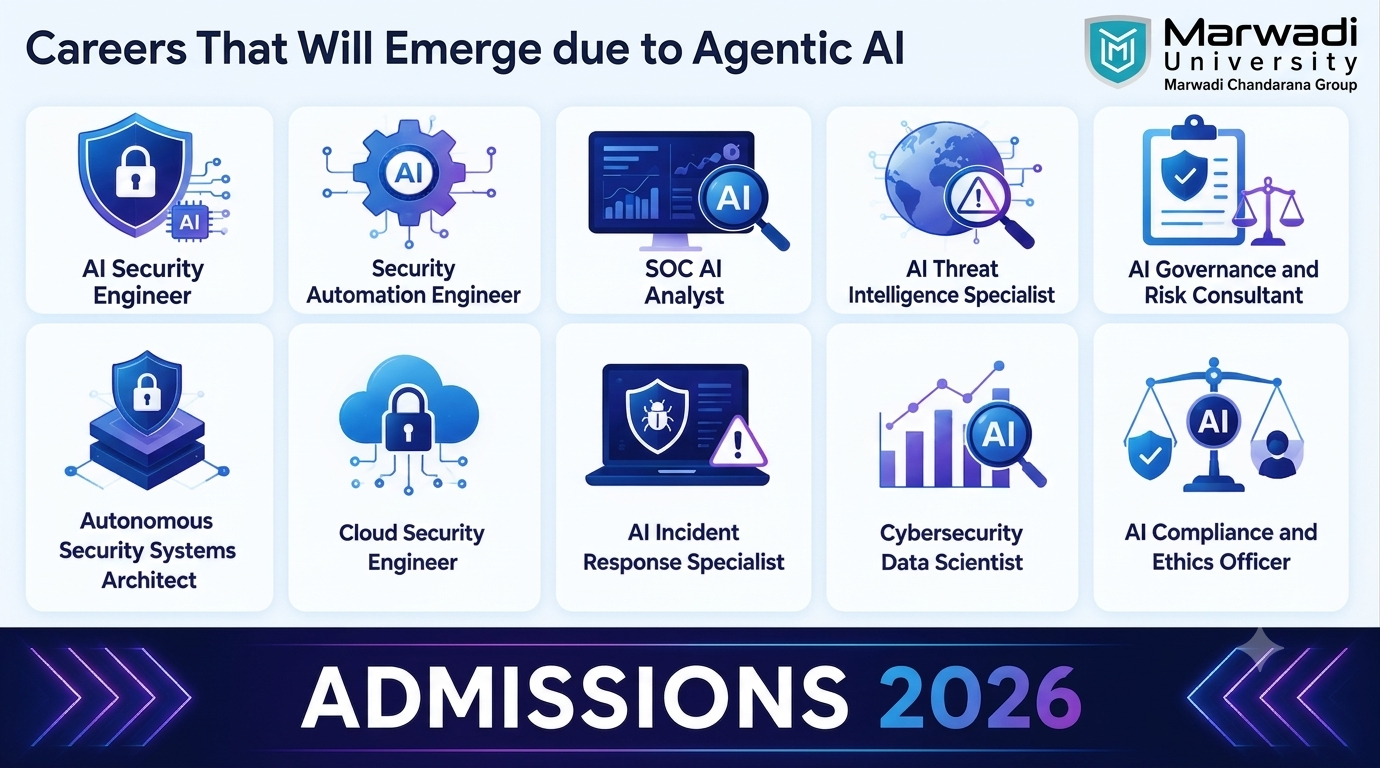
Some emerging Cybersecurity Careers include:
- AI Security Engineer
- Security Automation Engineer
- SOC AI Analyst
- AI Threat Intelligence Specialist
- AI Governance and Risk Consultant
- Autonomous Security Systems Architect
- Cloud Security Engineer
- AI Incident Response Specialist
- Cybersecurity Data Scientist
- AI Compliance and Ethics Officer
The Future of Cybersecurity Jobs will involve professionals who understand both cybersecurity principles and AI technologies. Organizations across banking, healthcare, manufacturing, government, education, and technology sectors are investing heavily in AI-powered security solutions.
Professionals with knowledge of AI, cloud computing, ethical hacking, digital forensics, and automation will enjoy excellent career growth and competitive salaries.
According to industry reports, cybersecurity remains one of the fastest-growing career fields globally, and AI is expected to further increase demand for skilled professionals who can secure intelligent systems.
For today’s students, learning these technologies is not just an advantage, it is becoming a necessity.
Skills Employers Want
Technology is evolving quickly, and employers are looking for graduates who possess both technical expertise and problem-solving abilities.
Some of the most valuable AI Security Skills include:
- Understanding AI and Machine Learning fundamentals
- Network Security
- Cloud Security
- Python Programming
- Security Automation
- Threat Hunting
- Malware Analysis
- Digital Forensics
- Identity and Access Management
- Risk Assessment
- Security Monitoring
- Zero Trust Security
- AI Governance
- Data Privacy
- Prompt Engineering for AI systems
Employers also highly value Ethical Hacking Skills, as ethical hackers help organizations identify vulnerabilities before cybercriminals can exploit them.
In addition to technical expertise, communication, teamwork, analytical thinking, adaptability, and continuous learning are essential soft skills.
The Cybersecurity Skills 2026 employers seek are increasingly focused on professionals who can collaborate with AI systems rather than compete against them.
Why Students Should Start Learning Now
The cybersecurity landscape is evolving faster than ever, and Agentic AI in Cybersecurity is at the heart of this transformation. As organizations increasingly adopt AI-powered security solutions, students who start learning these technologies today will be better prepared for the careers of tomorrow.
Here are a few reasons why students should begin building these skills now:
- Stay ahead of industry trends: AI, automation, and cybersecurity are evolving rapidly. Learning these technologies early helps students remain competitive in the job market.
- Meet employer expectations: Companies are looking for graduates who understand AI, cloud computing, automation, and cybersecurity, not just traditional security concepts.
- Build practical experience: Participating in certifications, internships, hackathons, cybersecurity competitions, and real-world projects helps students develop industry-ready skills.
- Strengthen technical expertise: Learning programming languages like Python, experimenting with AI tools, participating in Capture the Flag (CTF) competitions, and gaining hands-on experience with cloud platforms can significantly improve a student’s resume.
- Develop adaptability and confidence: Students who continuously learn emerging technologies become more confident, adaptable, and valuable to employers in an ever-changing digital world.
As Agentic AI continues to reshape cybersecurity, today’s learners have the opportunity to become tomorrow’s cybersecurity leaders and innovators.
How Marwadi University Prepares Students
Marwadi University is committed to preparing students for the future of cybersecurity by combining academic excellence with practical, industry-focused learning. The university equips students with the technical knowledge and hands-on experience needed to thrive in an AI-driven digital world.
Here’s how Marwadi University helps students build future-ready careers:
- Industry-oriented curriculum: Students develop strong foundations in networking, cloud computing, ethical hacking, digital forensics, secure software development, and cybersecurity fundamentals.
- Hands-on practical learning: Modern laboratories, real-world projects, coding sessions, workshops, and expert-led training help students apply classroom knowledge to real-world challenges.
- Exposure to emerging technologies: The curriculum introduces students to Artificial Intelligence, Machine Learning, automation, cybersecurity analytics, and other cutting-edge technologies shaping the future of cybersecurity.
- Career-focused opportunities: Students are encouraged to pursue industry certifications, internships, research projects, hackathons, and cybersecurity competitions that enhance technical expertise and employability.
- Strong industry readiness: Through innovation-driven education and practical exposure, students graduate with the confidence, problem-solving abilities, and future-ready skills needed to excel in AI-Powered Cybersecurity and other high-demand technology careers.
With its focus on academic quality, practical learning, and industry relevance, Marwadi University empowers students to become skilled cybersecurity professionals ready to tackle tomorrow’s digital security challenges.
Final Thoughts
The future of digital security is no longer driven only by human expertise, it is increasingly powered by intelligent machines. Agentic AI in Cybersecurity is transforming how organizations detect threats, respond to incidents, and protect valuable digital assets. As AI continues to evolve, it will create new opportunities, redefine existing job roles, and increase the demand for skilled cybersecurity professionals.
For students, this is the perfect time to explore AI, cybersecurity, cloud computing, automation, and ethical hacking. Building expertise in these areas will not only improve career prospects but also prepare them to solve some of the world’s most complex digital security challenges.
The future belongs to professionals who can work alongside intelligent AI systems. By learning Agentic AI in Cybersecurity today, students can stay ahead of technological changes, unlock exciting career opportunities, and become leaders in one of the fastest-growing industries in the world.
Whether your goal is to become an AI Security Engineer, SOC Analyst, Ethical Hacker, or Cybersecurity Consultant, investing in these future-ready skills today will help you build a successful and rewarding career tomorrow.
FAQs
1. What is Agentic AI in Cybersecurity?
Agentic AI in Cybersecurity refers to AI systems that can independently detect, analyze, and respond to cyber threats with minimal human intervention.
2. Is AI replacing cybersecurity professionals?
No. AI supports cybersecurity professionals by automating repetitive tasks, while humans continue to handle complex decision-making and strategic security planning.
3. What skills are required for future cybersecurity careers?
Key skills include AI fundamentals, cloud security, Python, ethical hacking, digital forensics, security automation, and problem-solving.
4. What career opportunities are available in AI-powered cybersecurity?
Students can pursue roles such as AI Security Engineer, SOC Analyst, Threat Intelligence Specialist, Cloud Security Engineer, Security Automation Engineer, and Cybersecurity Consultant.
5. Why should students learn Agentic AI now?
Learning Agentic AI early helps students stay ahead of industry trends, develop in-demand skills, and improve their chances of securing high-growth cybersecurity careers.