Why Domain Knowledge in Data Science Beats Coding: The Secret Skill AI Cannot Replace

Domain knowledge in data science is quickly becoming the most important skill for students and professionals entering the AI era. While coding, tools, and machine learning models are still essential, they are no longer enough to succeed on their own.
Today, many students assume that learning Python, statistics, and machine learning is the complete path to becoming a data scientist. But in real-world jobs, companies are not just hiring coders, they are hiring problem solvers who understand business context.
This is where domain knowledge in data science becomes a game changer. It helps data scientists understand the meaning behind data in a specific industry like healthcare, finance, marketing, or education. Without this understanding, even advanced models can produce results that are technically correct but practically useless.
As AI tools become more powerful, they can now write code, build models, and generate insights automatically. This has changed what companies expect from professionals. The importance of domain knowledge in data science is increasing because it helps humans do what AI cannot understand real-world problems and make meaningful decisions.
Marwadi University ranks Top 40 internationally in QS Asia by subject for Computer Science and Engineering. Besides, the university holds Top 200-300 NIRF ranking nationally, has NAAC A+ grade, NBA Tier-1 programs and Centre of Excellence award by Govt. of Gujarat.
In this blog, we will explore why domain knowledge is becoming more important than coding, and how it shapes the future of data science careers.
What is Domain Knowledge in Data Science?
Domain knowledge in data science means understanding the industry where data is being used and what the data actually represents in real life. It is not just about tools or coding, but about interpreting data in the correct business or industry context.
For example:
- Healthcare: Understanding diseases, symptoms, patient history, and medical reports
- Finance: Understanding transactions, fraud detection, loans, and risk patterns
- Marketing: Understanding customer behavior, sales patterns, and campaign performance
Why it matters:
- Helps connect data with real-world meaning
- Improves accuracy of analysis
- Helps ask better business questions
- Turns raw data into actionable insights
Without domain knowledge:
- Data remains confusing and incomplete
- Models may give correct output but wrong conclusions
With domain knowledge:
- Data becomes meaningful and decision-driven
Importance of Domain Knowledge in Data Science
The importance of domain knowledge in data science is huge because it directly improves the quality of insights and decisions.
How it helps data scientists:
- Selects the right features from data
- Removes irrelevant or misleading data
- Improves interpretation of results
- Helps ask the right business questions
Example:
In a hospital dataset:
- Knowing important symptoms improves prediction accuracy
- Without medical understanding, models may miss key signals
Key benefits:
- Better decision-making
- More accurate models
- Real-world relevant insights
- Reduced errors in analysis
Data with domain knowledge gives meaningful insights while data without context is only confusion.
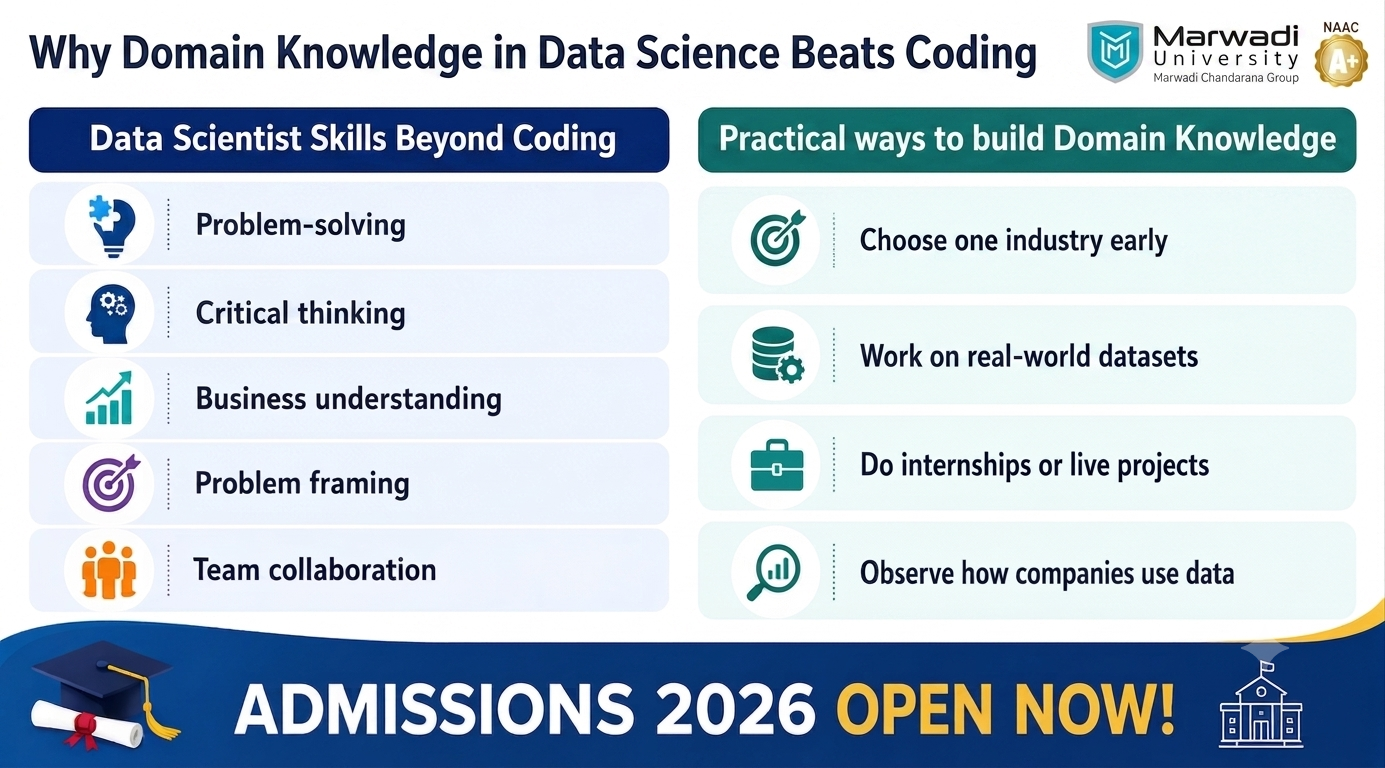
Data Scientist Skills Beyond Coding
Modern data science requires much more than programming. Companies now look for a complete skill set beyond technical ability.
Important data scientist skills beyond coding:
- Problem-solving: Breaking complex problems into simple parts
- Critical thinking: Evaluating data logically
- Communication skills: Explaining insights clearly
- Business understanding in data science: Aligning work with business goals
- Problem framing: Asking the right question before analysis
- Team collaboration: Working with non-technical teams
Why these matter:
- Helps convert data into business decisions
- Improves teamwork and project success
- Makes insights easier to understand
Technical skills build models while non-technical skills create impact.
Why Coding Alone is Not Enough in 2026
Coding is still important in data science, but it is no longer the most valuable skill on its own. With AI tools and automation, many technical tasks are becoming easier.
What AI can now do:
- Write Python code automatically
- Build machine learning models
- Clean and visualize data
- Generate basic insights
This raises a common question: is AI replacing data scientists?
The reality:
- AI is not replacing data scientists
- AI is changing the role of data scientists
Why coding alone is not enough:
- Coding does not define the business problem
- AI cannot understand context or goals
- Tools can automate technical work
Focus shift in 2026:
- Critical thinking over coding
- Problem understanding over model building
- Domain knowledge over syntax
Data Science Skills Required in 2026
The data science skills required in 2026 are evolving due to AI and automation.
Core technical skills:
- Data analysis and statistics
- Machine learning basics
- Understanding AI tools
Non-technical skills:
- Domain knowledge in data science
- Communication and storytelling
- Business thinking and strategy
- Problem-solving ability
Industry shift:
- Less focus on manual coding
- More focus on interpretation
- More focus on decision-making
Future trend:
- AI handles execution
- Humans handle thinking and decisions
Recruiters prefer candidates who are a combination of thinkers, problem solvers, and domain experts as Future Data Scientists instead of the ones who just excel at coding. Marwadi University provides total placement support to its students.
How Students Can Build Domain Knowledge
Students can develop strong domain knowledge through simple, consistent actions.
Practical ways to build domain knowledge:
- Choose one industry early
- Finance / Healthcare / Marketing / Sports
- Work on real-world datasets
- Kaggle projects
- Case studies
- Read industry content
- Business news
- Research reports
- Company case studies
- Do internships or live projects
- Understand real business problems
- Learn how decisions are made
- Observe how companies use data
- Marketing strategies
- Financial decisions
- Customer analytics
Key benefits:
- Builds real-world thinking
- Improves career readiness
- Makes students job-ready faster
Final Thoughts
The world of data science is changing rapidly. While coding is still important, it is no longer the defining skill for success.
Domain knowledge in data science has become the real differentiator that separates good data scientists from great ones. It helps professionals understand real-world problems, ask better questions, and create meaningful solutions.
As AI continues to automate technical tasks, the importance of domain knowledge in data science will only grow stronger. Machines can write code, but they cannot understand human problems, business goals, or industry challenges.
Students who focus only on coding may struggle in the future. But those who combine technical skills with domain understanding will be better prepared for the future of data science careers.
In the end, coding helps you build solutions but domain knowledge helps you build the right solutions. And that is the real secret skill AI cannot replace.
If you see your future in data science, admissions are open for 2026 at Marwadi University in the program BTech CSE Artificial Intelligence and Data Science.
FAQs
1. What is domain knowledge in data science?
It is the understanding of the industry or field where data is applied, such as finance, healthcare, or marketing.
2. Why is domain knowledge important in data science?
It helps in understanding real problems and improving the accuracy and relevance of data insights.
3. Is coding important for data science?
Yes, but it is only one part of the skill set. Problem understanding is equally important.
4. Can AI replace data scientists?
No, AI can automate tasks but cannot replace human judgment and business understanding.
5. What are data science skills required in 2026?
A mix of coding, domain knowledge, communication, and analytical thinking is required.