AI Skills Employers Want in 2026: AI vs Human Skills Explained
Artificial Intelligence is changing the way the world works. From healthcare and finance to marketing and engineering, AI tools are becoming a part of almost every industry. This has created excitement, but it has also created fear among students and parents. Many students now wonder if AI will replace jobs in the future, while parents worry about long-term job security and stable careers. These concerns are shaping the conversation around education and employability today.
The good news is that AI is not replacing humans completely. Instead, it is changing the kind of skills employers expect from candidates. Along with technical knowledge, companies are now looking for creativity, communication, leadership, and problem-solving abilities. This shift has made skill-based education more important than ever before.
Understanding the AI skills employers want in 2026 can help students prepare for the changing job market with confidence. The future belongs to people who can work with technology while also using human strengths. As industries evolve, students must focus on developing both technical expertise and human skills to build successful and future-ready careers in 2026.
How AI is Changing Every Career in 2026
Artificial Intelligence is transforming every sector. Whether someone wants to become a software engineer, doctor, designer, marketer, entrepreneur, or financial analyst, AI tools are now becoming a part of daily work. The future workplace will not only depend on degrees but also on adaptability and continuous learning.
AI can automate repetitive tasks, analyze large amounts of data, and improve efficiency. For example:
- Marketing professionals use AI for content suggestions and audience analysis.
- Healthcare professionals use AI for diagnostics and patient data management.
- Finance companies use AI for fraud detection and automation.
- Engineers use AI-powered tools for design, coding, and testing.
This proves that AI is not replacing all jobs, but it is changing every job. Students entering the workforce must understand how technology is reshaping industries and prepare accordingly.
The conversation around AI vs human skills is becoming increasingly important because employers now want professionals who can combine AI knowledge with human intelligence. This is why students must focus on developing the skills needed in the AI era instead of fearing technological change.
How AI is Changing Hiring in 2026
The hiring process has changed significantly in recent years. Earlier, recruiters mainly focused on academic scores and technical qualifications. Today, employers are paying more attention to practical skills, adaptability, and problem-solving abilities.
One of the biggest trends in how AI is changing hiring in 2026 is the growing demand for candidates who understand both technology and human interaction. Companies want employees who can use AI tools effectively while also bringing creativity and emotional understanding to the workplace.
Some of the major skills employers look for in 2026 include:
- AI literacy and digital awareness
- Communication and collaboration
- Critical thinking
- Data interpretation
- Leadership abilities
- Creativity and innovation
- Adaptability to change
Recruiters are also focusing more on internships, live projects, portfolios, certifications, and industry exposure rather than only theoretical knowledge. This shift is creating more opportunities for students who actively build practical skills during their education.
As the relationship between AI and jobs future continues to evolve, students who can balance technology with human-centered thinking will stand out in the job market.
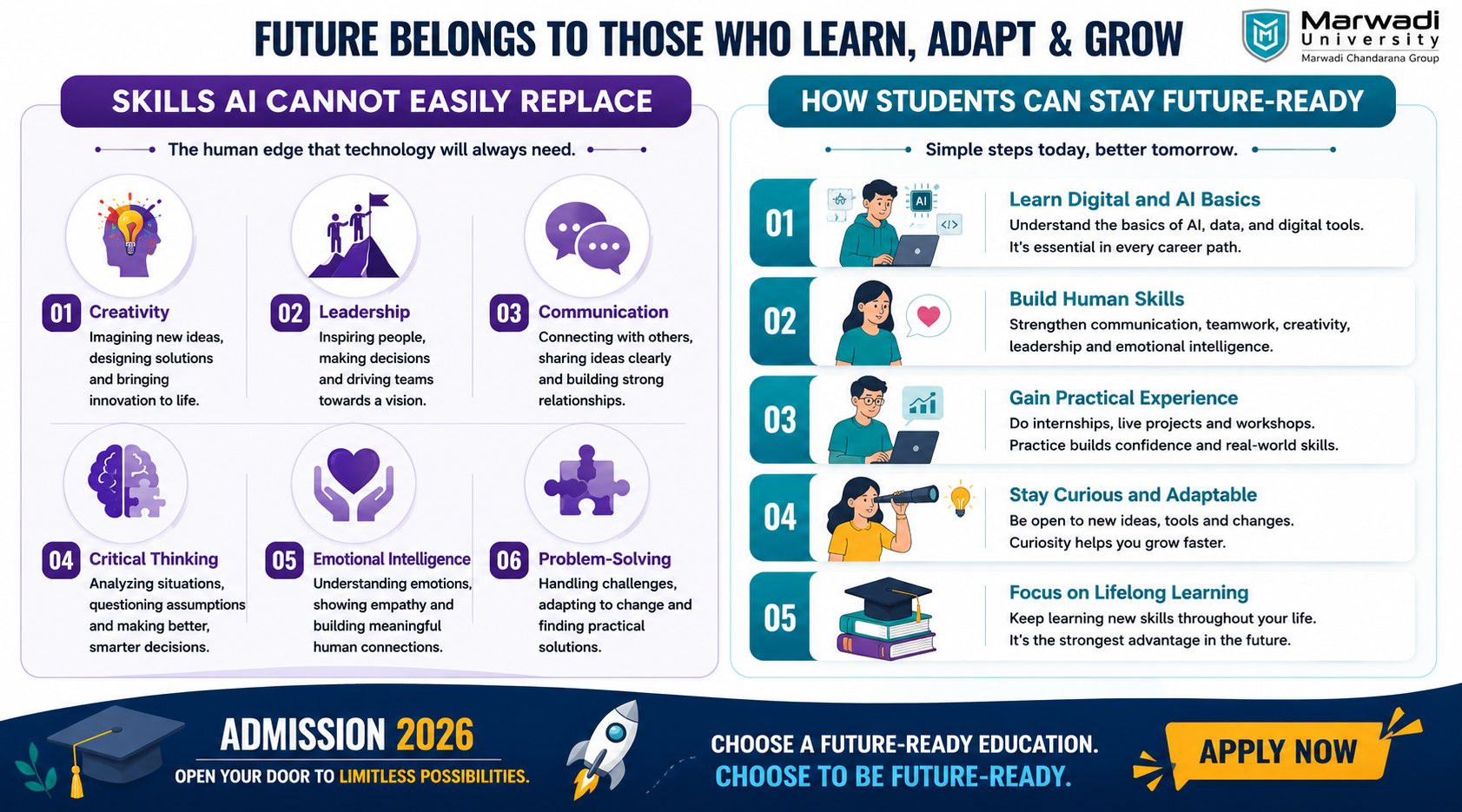
Skills AI Cannot Easily Replace
Even though AI is advancing rapidly, there are certain human abilities that technology cannot easily replicate. These are becoming the most valuable AI-proof skills for future jobs.
1. Creativity
AI can generate ideas, but human creativity remains unique. Businesses still need people who can think differently, create original solutions, and bring innovation to products and services.
2. Leadership
Strong leadership requires decision-making, empathy, motivation, and team management. AI can assist with data, but it cannot replace human leadership qualities.
3. Communication
Effective communication is one of the top employability skills for students today. Companies value professionals who can clearly express ideas, collaborate with teams, and build relationships with clients.
4. Critical Thinking
AI provides information, but humans must analyze situations, question assumptions, and make thoughtful decisions. Critical thinking is essential for solving complex business and social challenges.
5. Emotional Intelligence
Understanding emotions, managing relationships, and showing empathy are important in workplaces. These are among the key human skills AI cannot replace.
6. Problem-Solving
Every industry faces unpredictable challenges. Employers need professionals who can think calmly, adapt quickly, and find practical solutions.
These human-centered abilities are becoming more valuable as automation grows. Students who develop these qualities will have stronger opportunities in future-ready careers 2026.
Why Universities Must Adapt
The changing job market is also transforming the role of universities. Educational institutions can no longer focus only on traditional classroom teaching. They must prepare students for real industry challenges and emerging technologies.
Universities today need:
- Industry collaborations
- Project-based learning
- Skill-focused curriculum
- Innovation and entrepreneurship support
- Internship opportunities
- Exposure to AI and digital tools
This is why many institutions are now focusing on experiential learning and technology-driven education models.
Marwadi University Gujarat has positioned itself as a technology and innovation-driven university by encouraging practical learning, industry exposure, research, and entrepreneurship. Such approaches help students become more adaptable to the changing demands of employers.
The University holds NAAC A+ grade and has NBA Tier-1 programs. It ranks 353 in QS Asia ranking and holds Top 100-125 in NIRF ranking. It is also awarded as Centre of Excellence by Govt. of Gujarat.
To prepare students for the future, universities must move beyond rote learning and focus on building the future skills for students that industries truly value.
How Students Can Stay Future-Ready
Students do not need to fear AI. Instead, they should learn how to grow alongside technology. The key is continuous skill development and adaptability.
Here are some practical ways students can stay future-ready:
1. Learn Digital and AI Basics
Students from every field should understand basic AI concepts, digital tools, and data literacy.
2. Build Human Skills
Communication, teamwork, creativity, and emotional intelligence are becoming equally important as technical knowledge.
3. Gain Practical Experience
Internships, projects, workshops, and certifications help students develop industry-relevant skills.
4. Stay Curious and Adaptable
Technology changes quickly. Students who are open to learning new tools and ideas will perform better in the future job market.
5. Focus on Lifelong Learning
Education should not stop after graduation. Continuous upskilling is becoming essential for long-term career growth.
Today, employability-focused admissions and skill-based education are helping students prepare for the realities of modern workplaces. The goal is not just getting a degree but becoming capable of handling future industry changes confidently.
Final Thoughts
The future of work is not about choosing between humans and AI. It is about understanding how both can work together effectively. As industries continue to evolve, employers are looking for professionals who can combine technical knowledge with human-centered skills such as creativity, communication, leadership, and critical thinking.
The growing importance of the AI skills employers want in 2026 shows that career success will depend on adaptability and continuous learning. Students who focus only on academic marks may struggle to keep up with changing industry expectations. On the other hand, students who build practical experience, digital awareness, and strong interpersonal abilities will be better prepared for long-term success.
The discussion around AI vs human skills is not about competition but collaboration. AI can improve efficiency and automate tasks, but human intelligence, empathy, innovation, and decision-making remain irreplaceable.
Education in the coming years must focus on preparing students for change rather than preparing them for one fixed role. Universities, educators, and students all have an important role in building a workforce that is flexible, skilled, and future-ready. In a rapidly changing world, adaptability will become the most valuable skill of all.
Marwadi University supports its students in many ways including training, industry exposure and practical learning for the ongoing AI revolution. If your goal is to become a future-ready leader, you have come to the right place.
FAQs
1. Will AI replace jobs completely in the future?
No, AI will not replace all jobs. It will mainly automate repetitive tasks while creating new career opportunities that require human creativity and problem-solving.
2. What are the top employability skills for students in 2026?
Communication, adaptability, critical thinking, creativity, leadership, and AI literacy are among the most important skills.
3. What are the human skills AI cannot replace?
Emotional intelligence, creativity, leadership, empathy, and complex decision-making are difficult for AI to replace.
4. Why are universities focusing more on skill-based education?
Industries now prefer candidates with practical knowledge and real-world skills that comes under skill based education instead of only theoretical learning.
5. How can students prepare for future-ready careers in 2026?
Students should focus on continuous learning, internships, digital skills, AI awareness, and developing strong human skills.