10 Must-Have Skills for Engineering Students for a Successful Career in 2026
Engineering is no longer only about knowing formulas, machines, or code. In 2026, employers are looking for graduates who can combine technical knowledge with problem-solving, communication, adaptability, and digital confidence. As industries adopt artificial intelligence, automation, data-driven decision-making, and sustainable technologies, students need to prepare for workplaces that are changing quickly.
This makes skills for engineering students an important part of career preparation. A strong engineering degree gives you the foundation, but practical and professional skills help you turn that knowledge into real-world value. Whether you are studying computer, mechanical, civil, electrical, chemical, or another engineering discipline, building the right skills before graduation can improve your confidence and employability.
So, what should engineering students learn before entering the job market? From technical expertise and AI awareness to teamwork and communication, several abilities can make a meaningful difference. The good news is that you do not need to master everything at once.
You can develop these skills through projects, internships, competitions, online learning, teamwork, and consistent practice, and by actively learning from mentors, peers, and professionals regularly along the way.
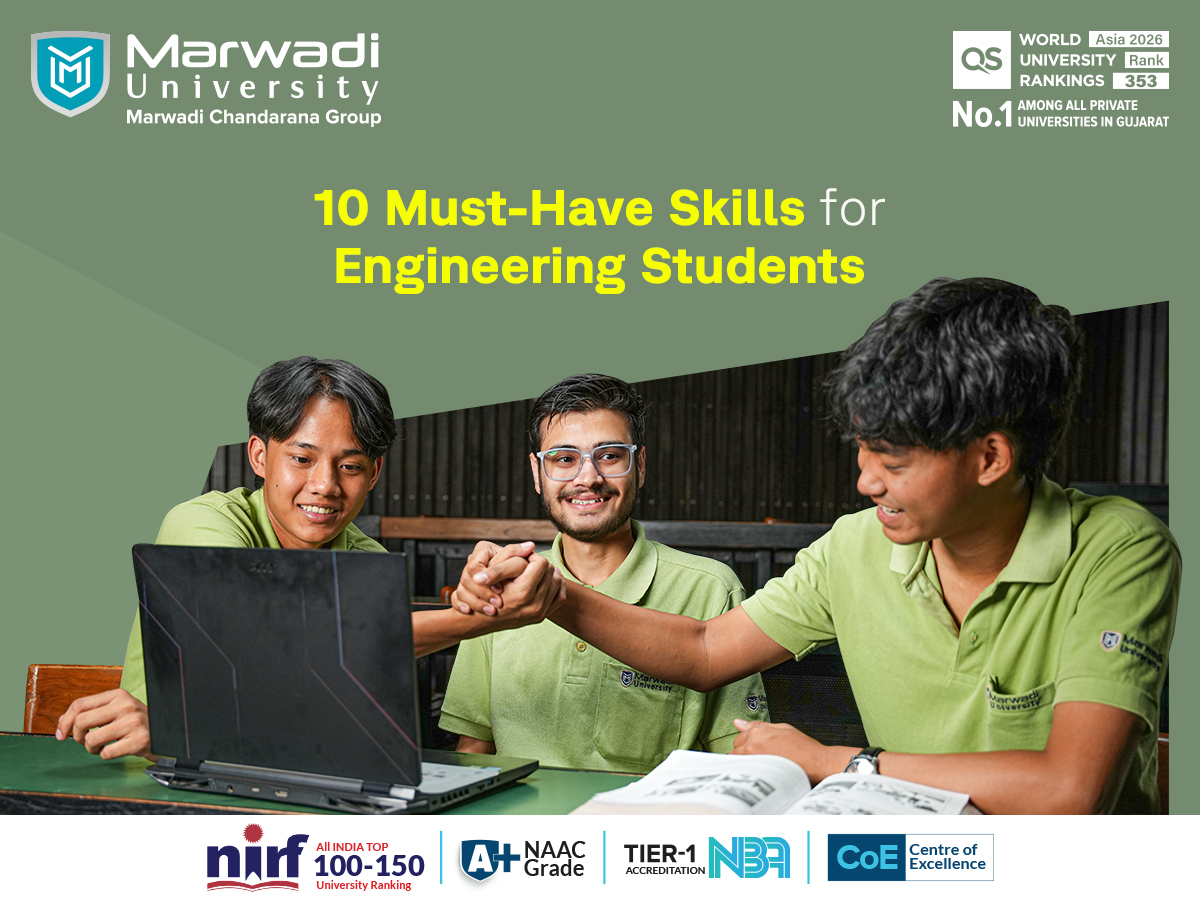
Marwadi University is NAAC A+ accredited, has NBA Tier-1 programs, a QS Asia rank of 353, a NIRF rank of 200- 300, and is awarded as a Centre of Excellence by the Government of Gujarat.
Here are 10 essential skills that can help you become more adaptable, job-ready, and prepared for a successful engineering career in 2026.
1. Problem-Solving
Problem-solving is one of the skills every engineering student should learn. Employers value graduates who can understand a problem, break it into smaller parts, compare solutions, and choose a practical approach. Do not focus only on exam answers. Practise solving real challenges through projects, case studies, coding exercises, design tasks, and competitions.
Build this skill by:
- Asking why a problem exists.
- Testing more than one solution.
- Learning from mistakes.
- Explaining your reasoning clearly.
Strong problem-solving helps you handle unfamiliar situations with confidence and become a dependable engineer. This skill also strengthens decision-making when pressure is high.
2. Technical and Digital Skills
Strong technical knowledge remains essential, but today’s engineers also need digital confidence. The right technical skills for engineering students depend on their branch and career goals. Computer engineering students may need programming, databases, cloud, or cybersecurity, while mechanical students may benefit from CAD, simulation, robotics, or automation.
Focus on:
- Core engineering concepts.
- Industry-relevant software and tools.
- Basic programming or data literacy.
- Hands-on projects.
Do not collect certificates without practice. Build meaningful work that shows employers you can use your knowledge to solve real engineering problems. Keep updating your toolkit as industry needs evolve for your career.
3. Artificial Intelligence Literacy
Artificial intelligence is becoming part of engineering workflows across industries. That makes AI skills for engineering students valuable, even for students who do not plan to specialise in AI. Engineers should understand how AI can support design, analysis, automation, research, and decision-making.
Start with:
- Basic AI concepts.
- Responsible use of AI tools.
- Prompting and AI-assisted productivity.
- Data interpretation and validation.
- Awareness of AI limitations.
The goal is not to let AI replace your thinking. Learn to use it intelligently while checking outputs, protecting information, and using engineering judgement. This makes you more productive and adaptable.
4. Data and Analytical Thinking
Modern engineering decisions increasingly depend on data. Learning to collect, interpret, visualise, and communicate information is among the best skills for engineering students. Data literacy is useful across branches, whether analysing machine performance, construction measurements, energy consumption, product quality, or operations.
Develop this ability by:
- Learning spreadsheets and basic visualisation.
- Understanding trends and basic statistics.
- Practising data interpretation.
- Asking what data actually means.
- Connecting findings to engineering decisions.
You do not need advanced data science skills. What matters is being comfortable with information and using evidence to support decisions rather than relying only on assumptions.
5. Communication
Good engineering ideas have limited impact if you cannot explain them. Communication is among the essential employability skills for engineering students. Engineers work with teammates, managers, clients, technicians, and non-technical teams. Explaining complex information simply can make work easier to understand and implement.
Practise:
- Writing clear emails, reports, and documentation.
- Presenting projects confidently.
- Explaining technical ideas without jargon.
- Listening carefully and asking useful questions.
- Adapting communication to different audiences.
Improve through presentations, group projects, and interviews. Clear communication does not mean complicated words. It means making your message accurate, structured, concise, and easy to understand.
6. Teamwork and Collaboration
Engineering rarely happens alone. Projects require people with different backgrounds to coordinate, share ideas, manage responsibilities, and solve disagreements. That is why soft skills for engineering students are as important as technical knowledge. Employers want graduates who contribute to teams while owning their work.
Build collaboration skills by:
- Participating actively in team projects.
- Dividing responsibilities fairly.
- Respecting different viewpoints.
- Giving and receiving feedback.
- Taking responsibility when things go wrong.
Student clubs, hackathons, and provide useful practice. Learn to be both a reliable contributor and a confident communicator. Teamwork helps you perform better in engineering workplaces daily.
7. Adaptability and Continuous Learning
Technology, tools, and roles can change, so engineers cannot depend only on college. One of the most important future skills for engineers is the ability to learn and adapt. A popular tool today may be replaced tomorrow, while new roles may emerge around new technologies.
Build adaptability by:
- Following developments in your industry.
- Learning relevant skills.
- Taking short courses or workshops.
- Experimenting with unfamiliar tools.
- Seeking feedback from mentors.
Treat graduation as the beginning of continuous learning. Curious, flexible engineers can respond confidently to new technologies, responsibilities, and career opportunities in their careers today.
8. Project Management
Knowing how to complete an engineering task is useful; knowing how to deliver it on time and within constraints is even more valuable. Project management is among the practical job-ready skills for engineering students because engineers work with deadlines, budgets, resources and teams.
Learn to:
- Break large tasks into manageable steps.
- Set realistic deadlines and priorities.
- Track progress.
- Document work.
- Coordinate with teammates.
- Review outcomes.
Practise through college projects, hackathons, internships, and student organisations. Basic planning improves reliability. Employers notice candidates who can move a project from an idea to a completed outcome consistently.
9. Creativity and Innovation
Engineering is not only about following existing methods. Many opportunities involve improving products, processes, systems, or services. Creativity helps engineers view familiar problems differently and develop solutions that are practical, efficient, and useful. It is therefore one of the skills to learn before engineering graduation.
Develop creative thinking by:
- Exploring different solutions.
- Studying how products can improve.
- Joining innovation challenges and hackathons.
- Combining ideas from different fields.
- Asking how technology can solve problems.
Creativity means generating possibilities and testing them against constraints. Combined with technical knowledge and problem-solving, creativity can help you create measurable value.
10. Professionalism and Career Readiness
Technical ability can open doors, but professionalism helps you build a career. Students should develop habits that show reliability, responsibility, and workplace readiness. These skills for engineering students can influence how recruiters view you during internships, interviews, and your first role.
Work on:
- Building a clear resume and professional profile.
- Preparing for technical and behavioural interviews.
- Creating a portfolio.
- Practising professional email etiquette.
- Learning networking.
- Showing punctuality, ownership, and integrity.
Start before your final semester. Small, consistent efforts can make your transition from student to professional smoother and help you present your abilities confidently.
Final Thoughts
A successful engineering career in 2026 requires more than a good academic record. A mix of technical and professional skills can help you stand out. The most valuable skills for engineering students take time to develop. You build them through projects, internships, and practice.
Start by choosing two or three skills that match your goal. Build proof of your abilities through projects and portfolios. Stay curious and ready to adapt as technology changes. Remember, becoming a successful engineer is a continuous journey. The skills you build can shape the opportunities you create tomorrow. They can also prepare you for workplace demands.
FAQs
1. What skills should engineering students learn in 2026?
Engineering students should develop technical knowledge, AI literacy, problem-solving, data skills, communication, teamwork, adaptability, project management, creativity, and professionalism.
2. Why are soft skills important for engineering students?
Soft skills help engineers communicate ideas, collaborate with teams, handle workplace challenges, and work effectively with people from different backgrounds.
3. Which technical skills are important for engineering students?
Important technical skills depend on the engineering branch but may include programming, data analysis, CAD, simulation, automation, cybersecurity, cloud computing, and specialised engineering software.
4. How can engineering students become job-ready?
Students can become job-ready through internships, practical projects, hackathons, industry-relevant courses, portfolios, communication practice, and interview preparation.
5. How can students develop engineering skills before graduation?
Students can develop engineering skills through hands-on projects, internships, competitions, online courses, student clubs, mentorship, self-learning, and consistent practice.