BTech ECE VLSI in 2026: Why India’s Semiconductor Boom Makes It the Smartest Engineering Choice
The world around us is becoming smarter every day. From smartphones and electric vehicles to artificial intelligence (AI), robotics, and advanced communication systems, every modern technology depends on powerful semiconductor chips. This growing demand for chips has created exciting career opportunities for students who want to build a future in electronics and technology.
BTech ECE VLSI is emerging as one of the most promising engineering choices in 2026 because it combines electronics fundamentals with advanced chip design technologies. With India’s growing focus on semiconductor manufacturing and chip development, students with expertise in Very Large Scale Integration (VLSI) are becoming highly valuable in the technology industry.
For students exploring engineering options after Class 12, choosing a future-ready specialization is an important decision. Unlike traditional electronics roles, VLSI offers opportunities in designing and developing the chips that power next-generation technologies.
The increasing demand for skilled professionals has expanded the BTech VLSI engineering scope in India, making it an attractive career path for aspiring engineers. Companies across semiconductor design, automotive electronics, telecommunications, AI hardware, and consumer electronics are looking for skilled VLSI engineers.
This blog explores why BTech ECE with VLSI specialization can be the right choice in 2026, covering career scope, skills, salary trends, placement opportunities, and why this field is gaining momentum in India’s semiconductor ecosystem.
What is BTech ECE VLSI?
BTech ECE VLSI is an undergraduate engineering program that focuses on Electronics and Communication Engineering (ECE) along with specialized knowledge of Very Large Scale Integration (VLSI) design.
VLSI technology involves designing and developing integrated circuits (ICs) that contain millions or even billions of transistors on a single chip. These chips are the foundation of devices such as smartphones, laptops, electric vehicles, medical equipment, satellites, and AI-powered systems.
A BTech ECE with VLSI specialization helps students understand both the theoretical concepts of electronics and practical aspects of semiconductor chip design. The program builds a strong foundation in areas such as digital electronics, microprocessors, embedded systems, semiconductor devices, and hardware design.
Students typically learn:
- Digital circuit design
- Semiconductor fundamentals
- Analog and mixed-signal circuits
- Microcontrollers and embedded systems
- Hardware description languages
- IC fabrication processes
- Chip verification and testing
With India’s semiconductor industry expanding rapidly, this specialization offers students a pathway into one of the fastest-growing technology sectors. The future scope of VLSI technology is strong because almost every emerging technology requires advanced chips for better performance, efficiency, and automation.
Skills and Tools Students Learn in BTech ECE VLSI
The semiconductor industry requires engineers who have both conceptual knowledge and practical skills. A BTech ECE VLSI program helps students develop technical expertise required for modern chip design and development.
Important skills required for VLSI engineers include:
- Digital Design Skills: Understanding logic circuits, processors, and hardware architecture.
- Programming Knowledge: Learning languages like Verilog, SystemVerilog, and Python for hardware design and automation.
- Circuit Design: Developing knowledge of analog, digital, and mixed-signal circuits.
- Verification Skills: Testing chip designs to ensure accuracy and performance.
- Problem-Solving Ability: Analysing complex hardware challenges.
Industry tools students are introduced to:
- Electronic Design Automation (EDA) tools
- FPGA development platforms
- Simulation and verification tools
- Hardware modelling tools
Hands-on experience with these tools helps students become industry-ready. The combination of electronics knowledge and practical design skills creates multiple VLSI career opportunities in India across semiconductor companies, research organisations, and technology firms.
Students who follow a structured chip design engineer career path can progress from roles like Design Engineer and Verification Engineer to advanced positions in semiconductor architecture and research.
Recruiter Expectations & Placement Opportunities
The semiconductor sector is experiencing strong growth due to increasing demand for advanced chips in industries such as automotive, AI, telecommunications, and consumer electronics.
Today, recruiters look for engineers who have:
- Strong fundamentals in electronics and semiconductor concepts
- Knowledge of VLSI design methodologies
- Experience with hardware design tools
- Understanding of chip verification processes
- Practical project experience
The growth of semiconductor manufacturing and design activities has increased semiconductor industry jobs in India. Companies are actively hiring professionals for roles such as:
- VLSI Design Engineer
- Physical Design Engineer
- ASIC Design Engineer
- Verification Engineer
- FPGA Engineer
- Embedded Systems Engineer
- Semiconductor Test Engineer
A student’s placement opportunities depend on technical skills, project experience, internships, and industry exposure. Engineering institutes that focus on practical learning, lab training, and industry-oriented curriculum help students prepare better for semiconductor careers.
With the right skills and knowledge, graduates of BTech ECE VLSI can explore opportunities with semiconductor companies, electronics manufacturers, and technology organisations working on next-generation innovations.
VLSI Engineer Salary Trends in India
One of the major reasons students are choosing semiconductor careers is the attractive growth potential. The demand for skilled professionals has positively influenced the VLSI engineer salary in India.
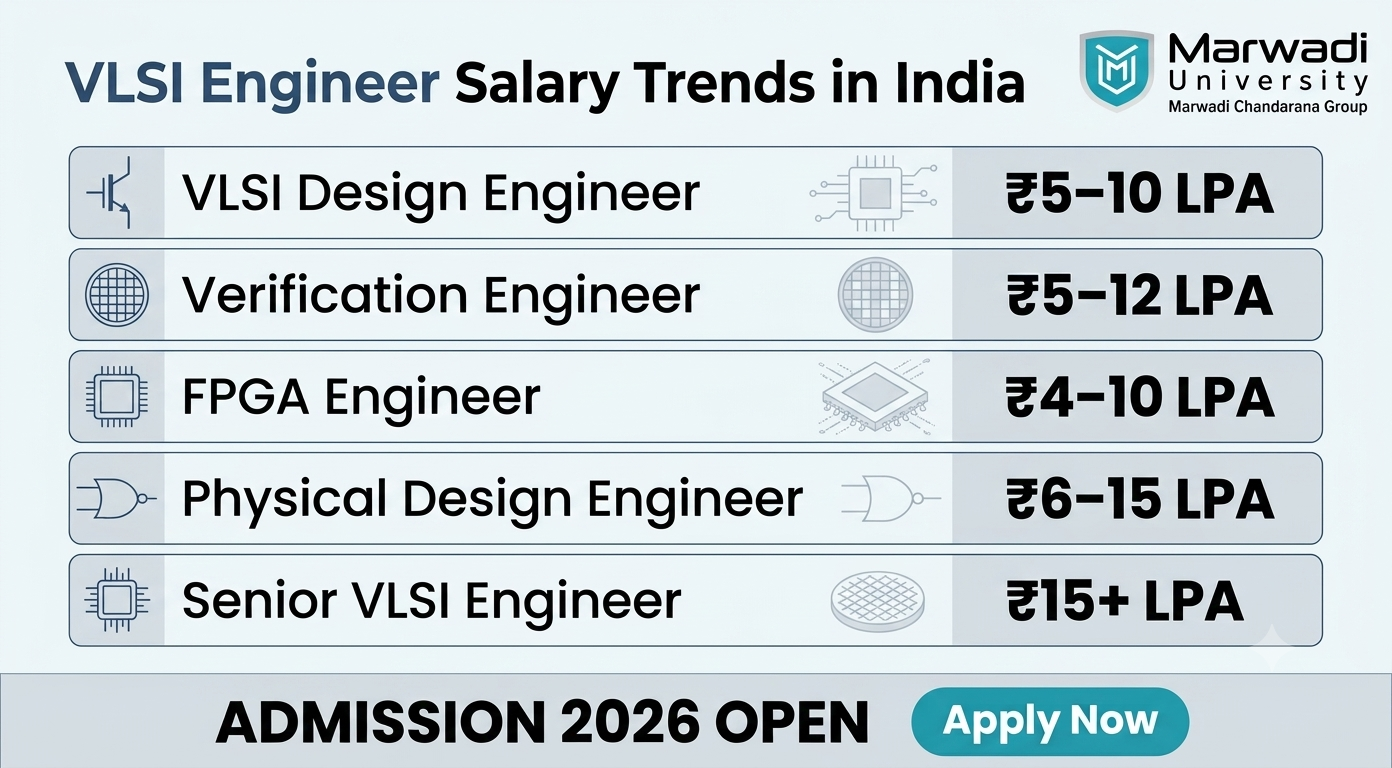
Salary levels depend on factors such as:
- Technical skills
- Industry experience
- Knowledge of semiconductor tools
- Company profile
- Job role
As professionals gain experience, their earning potential increases significantly. Continuous learning and expertise in advanced semiconductor technologies can help engineers move into leadership and specialised roles.
The increasing investments in India’s semiconductor ecosystem are expected to create more opportunities for skilled engineers, making VLSI a strong career choice for students looking for long-term growth.
Why Choose BTech ECE VLSI at Marwadi University?
Choosing the right university plays an important role in building a successful engineering career. Marwadi University focuses on providing students with industry-relevant education, practical exposure, and skill development opportunities.
The university holds NAAC A+ grade, NBA Tier-1 programs, Top 200-300 NIRF rank among national engineering colleges in India and is awarded the Centre of Excellence by Govt. of Gujarat.
Marwadi University has achieved a remarkable milestone by making its debut in the QS Asia University Rankings 2026, securing the prestigious Rank 353 among universities across Asia. This recognition highlights the university’s commitment to academic excellence, research, innovation, and global engagement making it Gujarat’s no.1 Private University.
The BTech ECE VLSI program at Marwadi University is designed to help students understand modern electronics and semiconductor technologies through a combination of classroom learning, laboratory practice, and industry-oriented training.
Key advantages include:
- Curriculum aligned with emerging semiconductor trends
- Practical exposure through advanced laboratories
- Focus on VLSI design concepts and applications
- Learning opportunities through projects and hands-on activities
- Guidance from experienced faculty members
- Career preparation through industry-focused initiatives
With India’s semiconductor industry moving towards self-reliance and innovation, students need the right combination of knowledge and practical skills. Marwadi University aims to prepare students for upcoming opportunities in electronics, semiconductor design, and chip development.
For students comparing ECE VLSI vs CSE which is better, the answer depends on individual interests. While CSE focuses mainly on software and computing, ECE VLSI offers opportunities to work on the hardware foundation behind modern technologies. Students interested in electronics, chip design, and emerging technologies can find exciting career opportunities in VLSI.
Final Thoughts
The rapid growth of India’s semiconductor ecosystem has created a new wave of opportunities for engineering students. As technology continues to advance, the demand for skilled professionals who can design and develop powerful chips will continue to increase.
Choosing BTech ECE VLSI in 2026 can be a smart decision for students who want to build a career in one of the most important technology sectors. From smartphones and AI systems to electric vehicles and communication networks, VLSI engineers play a crucial role in creating the technologies of tomorrow.
The expanding BTech VLSI engineering scope in India, increasing demand for semiconductor professionals, and attractive career growth make this specialization a future-focused choice. Students who develop strong technical knowledge, practical skills, and industry understanding can build rewarding careers in chip design and semiconductor engineering.
For students interested in electronics innovation and advanced technology, BTech ECE VLSI offers the opportunity to become part of India’s semiconductor growth story and contribute to the development of next-generation technologies.
FAQs
1. Is BTech ECE VLSI a good career option in 2026?
Yes, BTech ECE VLSI is a promising career option due to the growing demand for semiconductor and chip design professionals.
2. What is the scope of VLSI engineering in India?
The scope is expanding with growth in semiconductor manufacturing, AI chips, automotive electronics, and communication technologies.
3. What jobs can I get after BTech ECE VLSI?
Graduates can work as VLSI Design Engineers, Verification Engineers, FPGA Engineers, ASIC Engineers, and Semiconductor Engineers.
4. What skills are required for a VLSI engineer?
Important skills include digital design, Verilog, SystemVerilog, semiconductor knowledge, circuit design, and problem-solving abilities.
5. Is VLSI better than CSE?
Both fields offer strong careers. VLSI is ideal for students interested in electronics, hardware, and semiconductor technology, while CSE focuses more on software and computing.