8 Emerging Technologies in ECE That Will Define Future Engineering Careers
The world of electronics is changing faster than ever before. From smart devices and self-driving cars to intelligent healthcare systems and advanced communication networks, technology is becoming smarter with the help of Artificial Intelligence (AI). This is why staying updated with Emerging Technologies in ECE is essential for every Electronics and Communication Engineering (ECE) student.
Today’s industries are looking for engineers who can combine core electronics knowledge with AI, automation, and data-driven technologies. Whether you dream of working in robotics, semiconductor design, telecommunications, embedded systems, or smart manufacturing, learning these new technologies can give you a competitive edge.
The good news is that you don’t have to master everything at once. By understanding the latest trends and building skills in high-demand areas, you can prepare yourself for exciting career opportunities in the years ahead.
Marwadi University has achieved a remarkable milestone by making its debut in the QS Asia University Rankings 2026, securing Rank 353 in its very first appearance. This achievement marks the highest debut rank by an Indian private university and establishes Marwadi University as Gujarat’s No. 1 private university in the QS Asia Rankings.
The university also earned a place among Asia’s Top 100 for Internationalisation and Faculty Quality, reflecting its strong commitment to academic excellence, global collaborations, quality teaching, and industry-focused education. Besides, the university has NAAC A+ grade, NBA Tier-1 courses, Top 200-300 NIRF ranking for engineering colleges across India and is awarded Centre of Excellence by Govt. of Gujarat.
In this blog, we’ll explore eight emerging technologies that every ECE student should start learning today. These technologies are shaping industries worldwide and are expected to create thousands of new opportunities for engineers in the coming years.
Why Emerging Technologies Matter for ECE Students
The role of an Electronics and Communication Engineer has expanded significantly. Earlier, engineers mainly worked on communication systems, circuit design, and electronic hardware. Today, they are also involved in building intelligent devices that can learn, analyze data, and make decisions.
Learning future technologies for ECE students helps you stay ahead in an increasingly competitive job market. Companies now expect engineers to understand AI-powered hardware, connected devices, automation, and next-generation communication systems.
Some of the biggest benefits of learning these technologies include:
- Better placement opportunities
- Higher-paying career options
- Industry-ready technical skills
- Greater innovation and problem-solving abilities
- Opportunities to work on real-world AI applications
Developing these ECE skills for future jobs also prepares you for careers in sectors such as healthcare, automotive, aerospace, consumer electronics, telecommunications, and manufacturing. The earlier you begin exploring these technologies, the easier it becomes to build a successful engineering career.
8 Emerging Technologies Every ECE Student Should Learn
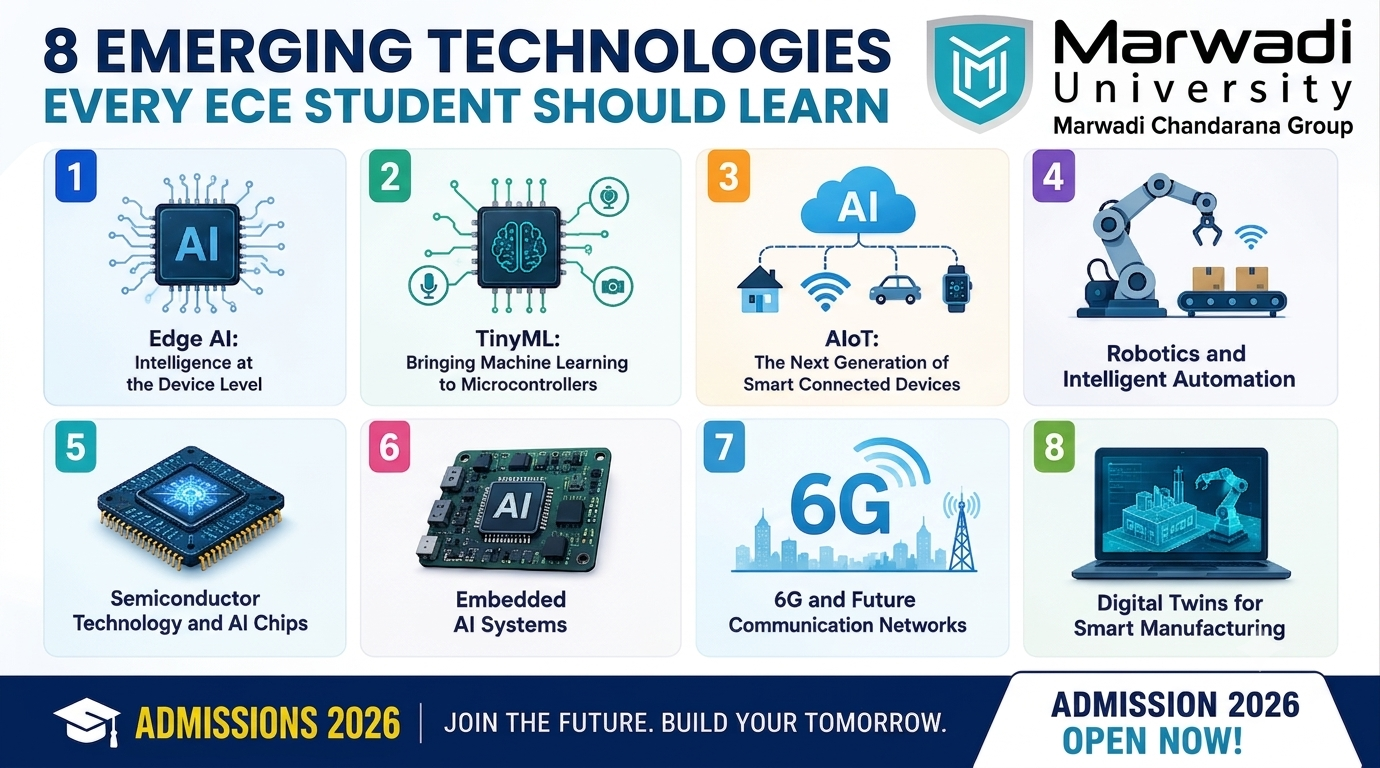
1. Edge AI: Intelligence at the Device Level
Traditionally, AI systems processed data in cloud servers. However, modern devices now perform AI computations directly on the device itself through Edge AI.
This technology reduces internet dependency, improves response time, and enhances data privacy.
Common applications include:
- Smart surveillance cameras
- Autonomous vehicles
- Industrial monitoring
- Wearable healthcare devices
- Smart home systems
As AI in Electronics and Communication Engineering continues to grow, Edge AI is becoming one of the most valuable skills for future engineers.
2. TinyML: Bringing Machine Learning to Microcontrollers
Imagine running machine learning models on a tiny microcontroller that consumes very little power. That’s exactly what TinyML makes possible.
TinyML enables engineers to build intelligent embedded devices that work efficiently without expensive processors or continuous cloud connectivity.
Popular applications include:
- Voice recognition devices
- Smart sensors
- Predictive maintenance
- Environmental monitoring
- Portable healthcare devices
Since TinyML combines embedded systems with artificial intelligence, it is becoming one of the fastest-growing fields in electronics engineering.
3. AIoT: The Next Generation of Smart Connected Devices
AIoT (Artificial Intelligence of Things) combines Artificial Intelligence with the Internet of Things (IoT). Instead of simply collecting data, connected devices can now analyze information and make intelligent decisions.
Examples include:
- Smart cities
- Connected factories
- Intelligent traffic management
- Smart agriculture
- Energy-efficient buildings
AIoT allows engineers to design smarter and more efficient systems that improve productivity and reduce operational costs. As industries adopt intelligent connected devices, AIoT knowledge is becoming highly valuable.
4. Robotics and Intelligent Automation
The future of engineering is closely linked with Robotics and Automation. Robots are now performing tasks in manufacturing, logistics, healthcare, agriculture, and even space exploration.
Modern robots use:
- Artificial Intelligence
- Computer vision
- Sensors
- Machine learning
- Embedded systems
For ECE students, robotics offers opportunities to work on hardware design, electronic control systems, sensor integration, and intelligent automation.
As industries continue embracing automation, robotics skills will remain in high demand.
5. Semiconductor Technology and AI Chips
The rapid growth of AI applications has created enormous demand for advanced Semiconductor technology.
Modern semiconductor chips power:
- Smartphones
- AI servers
- Electric vehicles
- Robotics
- Medical devices
- Consumer electronics
Engineers with knowledge of semiconductor manufacturing, VLSI design, chip architecture, and AI accelerators are becoming increasingly valuable.
With governments and industries investing heavily in semiconductor manufacturing, this field offers excellent long-term career opportunities.
6. Embedded AI Systems
Embedded systems have been part of electronics engineering for decades. Today, these systems are becoming smarter through Embedded AI.
Instead of simply following programmed instructions, embedded AI systems can:
- Detect patterns
- Make predictions
- Process sensor data
- Improve system performance
- Learn from user interactions
Applications include:
- Smart appliances
- Autonomous drones
- Medical equipment
- Industrial automation
- Intelligent transportation systems
Embedded AI combines electronics, programming, and machine learning, making it one of the most exciting interdisciplinary fields for ECE students.
7. 6G and Future Communication Networks
While many countries are still expanding 5G infrastructure, researchers are already working on 6G Technology.
6G aims to deliver:
- Extremely high-speed communication
- Ultra-low latency
- AI-powered wireless networks
- Holographic communication
- Advanced satellite connectivity
Future communication systems will require engineers who understand wireless communication, antennas, networking, signal processing, and AI-driven optimization.
Learning about next-generation communication technologies today will help students stay prepared for tomorrow’s telecom industry.
8. Digital Twins for Smart Manufacturing
Digital Twin technology creates a virtual copy of a physical system. Engineers can monitor, test, and improve equipment using digital simulations before making real-world changes.
Industries use Digital Twins for:
- Predictive maintenance
- Factory automation
- Product design
- Equipment monitoring
- Process optimization
For ECE students, Digital Twins combine electronics, sensors, AI, cloud computing, and industrial automation into one powerful technology. As Industry 4.0 and smart manufacturing continue to expand, Digital Twins are becoming an essential innovation to understand.
How Marwadi University’s BTech ECE with AI & ML Program Prepares You
Technology is evolving rapidly, and engineering education must evolve with it. Marwadi University’s BTech in Electronics and Communication Engineering with AI & ML is designed to help students build expertise in both core electronics and modern AI technologies.
The program provides a balanced learning experience by combining theoretical concepts with practical applications. Students gain exposure to topics such as artificial intelligence, embedded systems, machine learning, communication technologies, robotics, and intelligent automation.
The curriculum is designed to help students develop industry-relevant technical skills while working on projects that reflect real-world engineering challenges.
Students also benefit from:
- Industry-oriented curriculum
- Hands-on laboratory experience
- Project-based learning
- Exposure to AI-driven technologies
- Skill development for emerging industries
By learning both electronics and intelligent technologies together, graduates become well-prepared for careers in sectors such as smart manufacturing, telecommunications, semiconductor design, robotics, healthcare technology, and intelligent systems.
Final Thoughts
The future of engineering belongs to professionals who are willing to learn beyond traditional subjects. As industries continue adopting Artificial Intelligence, automation, smart communication, and intelligent electronics, engineers with modern technical skills will have a significant advantage.
Learning Emerging Technologies in ECE is one of the smartest investments you can make as a student. Technologies like Edge AI, TinyML, AIoT, Embedded AI, semiconductor technology, robotics, 6G communication, and Digital Twins are already transforming industries and creating exciting career opportunities.
You don’t need to become an expert overnight. Start by understanding these technologies, building practical skills through projects, and staying curious about new developments. Continuous learning will help you remain relevant in a rapidly changing technology landscape.
Choosing an engineering program that combines core electronics with AI-focused learning can also accelerate your career growth. By developing both technical knowledge and practical problem-solving skills, you’ll be better prepared to succeed in the next generation of engineering careers.
FAQs
1. Which emerging technology is most important for ECE students?
Edge AI, Embedded AI, AIoT, semiconductor technology, and robotics are among the most valuable technologies shaping the future of Electronics and Communication Engineering.
2. Why should ECE students learn Artificial Intelligence?
AI is transforming modern electronics by enabling smart devices, intelligent communication systems, automation, and advanced embedded applications, making it an essential skill for future engineers.
3. What is TinyML?
TinyML is the practice of running machine learning models on low-power microcontrollers, enabling intelligent features in compact electronic devices.
4. Is 6G technology relevant for current engineering students?
Yes. Although 6G is still under development, understanding its concepts prepares students for future careers in wireless communication and next-generation networking.
5. How can ECE students prepare for future engineering careers?
Students should strengthen their electronics fundamentals while learning AI, embedded systems, programming, robotics, semiconductor technology, and communication networks through practical projects and industry-focused education.