India’s Semiconductor Mission: Why 2026 is the Best Time to Build a Career in the Semiconductor Industry in India
The Semiconductor Industry in India is growing at an unprecedented pace, creating exciting opportunities for engineering students across the country. From smartphones and electric vehicles to artificial intelligence and smart devices, semiconductors power almost every modern technology we use today. As India strengthens its position in global chip design and manufacturing, the demand for skilled engineers is increasing rapidly.
With strong government support, major investments from global technology companies, and new educational initiatives, 2026 is shaping up to be one of the best years to pursue a chip design career. Students with a background in Electronics and Communication Engineering (ECE), Electrical Engineering (EEE), Computer Engineering, and related fields can now explore a wide range of semiconductor careers in India.
Whether you aspire to become a VLSI designer, verification engineer, embedded systems expert, or semiconductor manufacturing specialist, this is the perfect time to build industry-ready skills. Backed by NAAC A+ Accreditation, NBA Tier-I accredited programs, UGC recognition, QS Asia Rank #353, Centre of Excellence status by the Government of Gujarat, and Top 200-300 in NIRF ranking, Marwadi University offers a globally recognized, industry-focused learning experience.
In this blog, we’ll explore what’s driving the growth of the Semiconductor Industry in India, the latest developments, emerging career opportunities, essential skills, and why students should prepare now to be part of India’s semiconductor revolution.
What’s Fueling the Semiconductor Industry in India?
India is rapidly becoming an important destination for semiconductor design and manufacturing. A combination of government initiatives, industry investments, and rising global demand is accelerating the semiconductor industry growth in India.
1. Strong Government Support Through the India Semiconductor Mission
The Government of India has launched the India Semiconductor Mission with an investment of ₹76,000 crore to strengthen the country’s semiconductor ecosystem.
The mission focuses on:
- Establishing semiconductor fabrication (fab) facilities
- Encouraging chip design startups
- Building a highly skilled semiconductor workforce
- Supporting innovation in VLSI and embedded systems
- Reducing India’s dependence on imported semiconductor chips
These initiatives are expected to generate thousands of high-value engineering jobs over the coming years.
2. Massive Demand for Semiconductor Chips
The need for semiconductor chips continues to rise across multiple industries.
Today, chips are essential for:
- Smartphones and laptops
- Electric vehicles (EVs)
- Artificial Intelligence applications
- 5G communication networks
- Medical devices
- Industrial automation
- Smart cities and IoT devices
India’s semiconductor demand is projected to reach nearly $110 billion by 2030, creating enormous opportunities for professionals interested in semiconductor engineering and chip development.
3. Global Semiconductor Companies are Investing in India
India has become an attractive destination for leading semiconductor companies.
Several global players are expanding their presence through manufacturing plants, research centres, and design facilities, including:
- Micron
- AMD
- Foxconn
- Applied Materials
These investments are significantly increasing the demand for skilled professionals and creating more semiconductor jobs in India than ever before.
Recent Developments Accelerating India’s Semiconductor Revolution
India is not only investing in infrastructure but also preparing a future-ready workforce.
Some major developments include:
- AICTE has introduced updated curricula focused on VLSI Design & Technology and Integrated Circuit (IC) Manufacturing.
- A national plan aims to develop around 85,000 skilled professionals in semiconductor design over the next decade.
- More than 45,000 students from over 100 institutions have already enrolled in these specialized programs.
- The SMART Lab at NIELIT Calicut has already trained over 44,000 engineers and aims to train 1 lakh professionals across India.
- Collaborations with organizations such as Lam Research, IBM, and Purdue University are improving industry-focused learning.
- Under the Chips to Startup (C2S) programme, 278 academic institutions and 72 startups have received Electronic Design Automation (EDA) tools, benefiting over 60,000 students by August 2025.
These initiatives are making India one of the fastest-growing destinations for VLSI engineering education and research.
2025 Updates
India’s semiconductor ecosystem has witnessed several landmark developments.
1. India’s First Indigenous Semiconductor Chip
India is expected to unveil its first domestically developed semiconductor chip built using 28 to 90-nanometre technology, marking a significant milestone in the country’s semiconductor journey.
2. New Manufacturing Facilities
Several semiconductor manufacturing plants are currently under construction, including:
- Tata-Powerchip semiconductor plant in Gujarat
- Micron semiconductor facility in Sanand
These facilities are expected to create thousands of direct and indirect employment opportunities.
3. Record Investments
Major investments are strengthening India’s manufacturing ecosystem.
Some notable examples include:
- Tata Electronics investing approximately ₹910 billion in Gujarat
- Additional investments of ₹270 billion in Assam for semiconductor production
4. Global Technology Partnerships
International collaborations with companies like Foxconn and Renesas are bringing advanced semiconductor technologies and manufacturing expertise to India, opening new career opportunities for engineering graduates.
What This Means for Electronics Engineers
The semiconductor industry is no longer limited to experienced researchers or overseas professionals.
Today’s engineering graduates can directly explore rewarding VLSI career opportunities across multiple domains.
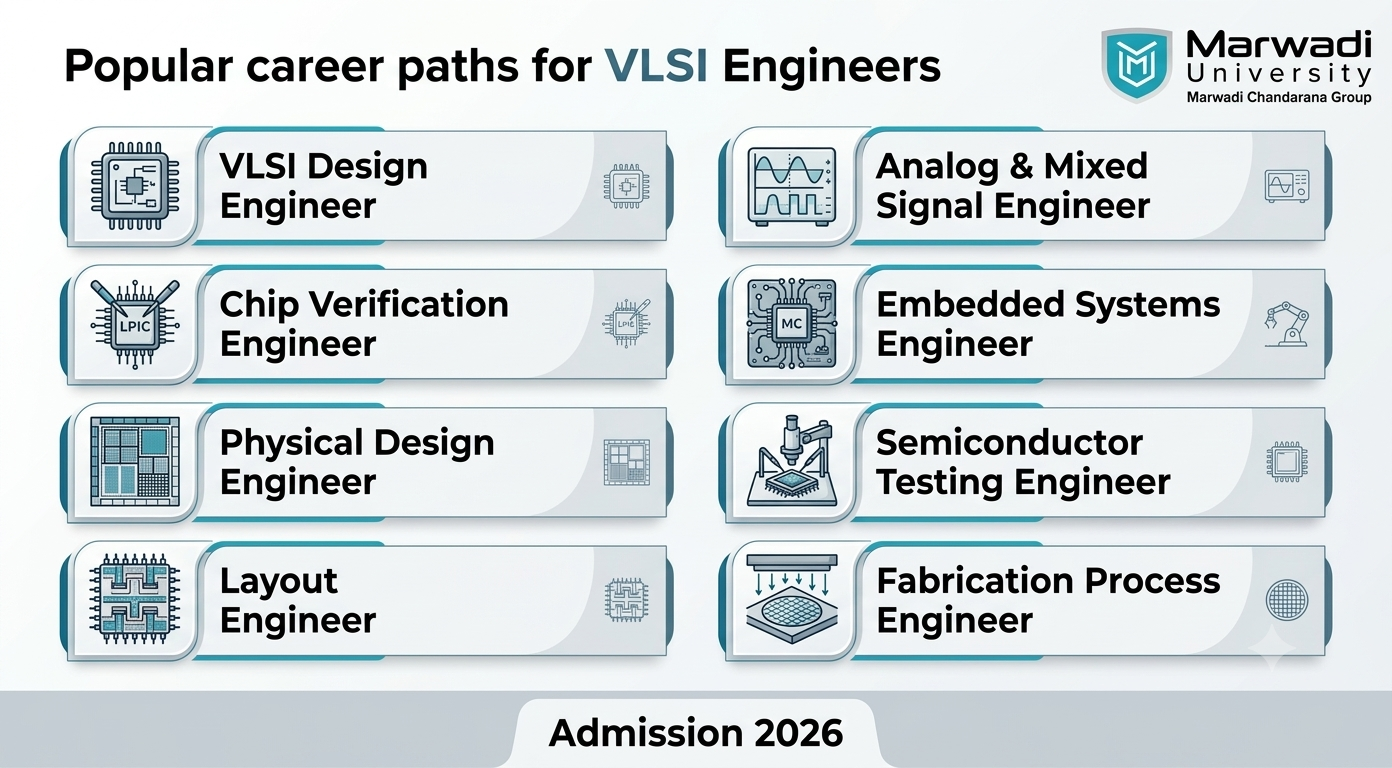
Popular career paths include:
- VLSI Design Engineer
- Chip Verification Engineer
- Physical Design Engineer
- Layout Engineer
- Analog & Mixed Signal Engineer
- Embedded Systems Engineer
- Semiconductor Testing Engineer
- Fabrication Process Engineer
As India’s semiconductor ecosystem continues to expand, fresh graduates with the right technical skills can build successful long-term careers in this high-growth sector.
Skills Required
Although hiring is increasing, employers are looking for candidates who possess practical skills alongside academic knowledge.
To build a successful chip design career, students should focus on developing the following competencies:
- Hands-on experience with EDA tools such as Cadence and Synopsys
- Knowledge of Verilog and SystemVerilog
- RTL Design concepts
- CMOS fundamentals
- Practical chip design projects
- Specialization in Digital Design, Verification, Physical Design, or Layout
- Industry-recognized certifications in VLSI and semiconductor technologies
Students who combine theoretical knowledge with practical exposure will have a clear advantage in the competitive job market.
Top Job Opportunities in India’s Semiconductor Industry
The rapid expansion of the industry is creating exciting career opportunities for engineering students.
Some of the most promising roles include:
1. Chip Design Engineer
Design integrated circuits used in consumer electronics, automotive systems, AI hardware, and communication devices.
Average chip design engineer salary in India: ₹15–20 LPA (depending on skills, company, and experience).
2. Semiconductor Manufacturing Engineer
Work inside advanced fabrication plants where semiconductor chips are manufactured.
Suitable for:
- Electronics Engineers
- Mechanical Engineers
- Chemical Engineers
- Materials Engineers
3. Testing & Packaging Engineer (ATMP)
Ensure semiconductor chips meet quality standards before commercial deployment.
Responsibilities include:
- Chip testing
- Failure analysis
- Quality assurance
- Packaging validation
4. Research & Development Engineer
Develop next-generation semiconductor technologies in research laboratories and innovation centres.
Many leading companies are expanding their R&D operations in India, creating exciting opportunities for students interested in innovation and advanced electronics.
Why Choose Marwadi University’s BTech ECE VLSI?
The rapid growth of the Semiconductor Industry in India is creating a strong demand for engineers with specialized knowledge in chip design and VLSI. To help students prepare for these emerging opportunities, Marwadi University has launched its BTech in Electronics and Communication Engineering VLSI. The program is designed to equip students with both theoretical knowledge and practical skills required to succeed in the semiconductor and electronics industry.
Students learn the fundamentals of electronics while gaining in-depth exposure to VLSI design, integrated circuits, semiconductor technology, embedded systems, and modern chip design practices. The curriculum emphasizes hands-on learning through laboratories, industry-oriented projects, and practical training, ensuring graduates are ready for real-world engineering challenges.
- Specialized curriculum focused on VLSI Design & Technology and semiconductor engineering.
- Industry-relevant learning aligned with the latest trends and demands of the semiconductor sector.
- Hands-on practical training through advanced laboratories, design tools, and project-based learning.
- Exposure to emerging technologies including embedded systems, IoT, AI, and integrated circuit design.
- Experienced faculty dedicated to building strong technical and problem-solving skills.
- Career-focused education that prepares students for roles such as VLSI Design Engineer, Chip Verification Engineer, Embedded Systems Engineer, Physical Design Engineer, and Semiconductor Testing Engineer.
- Strong placement support with opportunities to connect with leading recruiters across the electronics and technology industries.
With India’s semiconductor ecosystem expanding rapidly, pursuing a specialized program like BTech ECE VLSI and BTech ECE AI ML at Marwadi University can give students a competitive advantage. By combining industry-focused learning with practical experience, the program prepares aspiring engineers to build successful careers in one of the fastest-growing technology sectors of the future.
Final Thoughts
The Semiconductor Industry in India is entering a new era of innovation, investment, and employment. With large-scale government initiatives, growing global partnerships, advanced manufacturing facilities, and increasing demand for skilled engineers, India is becoming a major force in the global semiconductor ecosystem.
For students interested in electronics, embedded systems, integrated circuits, and VLSI, there has never been a better time to invest in the right education and technical skills. The growing number of semiconductor careers in India offers excellent salary prospects, long-term job security, and opportunities to work on technologies shaping the future.
Whether your goal is to become a chip designer, verification engineer, fabrication specialist, or embedded systems expert, building practical skills and choosing an industry-focused engineering program will help you stay ahead of the competition.
As the Semiconductor Industry in India continues to grow, students who prepare today will be ready to contribute to one of the country’s most exciting technology revolutions. If you’re planning your engineering journey, 2026 could be the perfect year to take the first step toward a rewarding career in chip design and VLSI.
FAQs
1. Why is the Semiconductor Industry in India growing so rapidly?
Government initiatives, increasing global investments, rising demand for electronic devices, and new semiconductor manufacturing facilities are driving rapid industry growth.
2. What are the best semiconductor careers in India?
Popular career options include VLSI Design Engineer, Chip Verification Engineer, Physical Design Engineer, Embedded Systems Engineer, Semiconductor Testing Engineer, and Fabrication Engineer.
3. What skills are required for a chip design career?
Students should learn Verilog, SystemVerilog, RTL Design, CMOS fundamentals, EDA tools like Cadence and Synopsys, and gain hands-on project experience.
4. What is the average chip design engineer salary in India?
Fresh graduates can earn around ₹15–20 LPA, while experienced professionals can earn significantly more depending on their expertise and organization.
5. Is VLSI engineering a good career choice in 2026?
Yes. With strong government support, growing investments, and increasing demand for semiconductor professionals, VLSI engineering is expected to remain one of the most promising engineering careers in the coming years.