AI vs Mechanical Engineering: 7 Myths Students Must Stop Believing in 2026
Will AI replace mechanical engineers? This is one of the biggest questions students ask while choosing an engineering career in 2026. With artificial intelligence transforming industries, many students wonder whether traditional engineering careers will disappear. The truth, however, is more balanced. AI is changing how engineers work, but it is not eliminating the need for engineering knowledge, creativity, problem-solving, and human decision-making.
The relationship between AI in mechanical engineering and traditional engineering is becoming increasingly important. From product design and manufacturing to robotics, electric vehicles, aerospace, and energy systems, artificial intelligence is helping engineers work faster and make better decisions.
The real question is not simply whether AI will replace engineers. It is how engineers can learn to work with AI.
In this blog, we will bust seven common myths about AI and mechanical engineering and explore what students should actually expect from the future of mechanical engineering with AI. If you are planning a mechanical engineering career in 2026, understanding these myths can help you make smarter academic and career decisions.
7 Myths Students Must Stop Believing in 2026
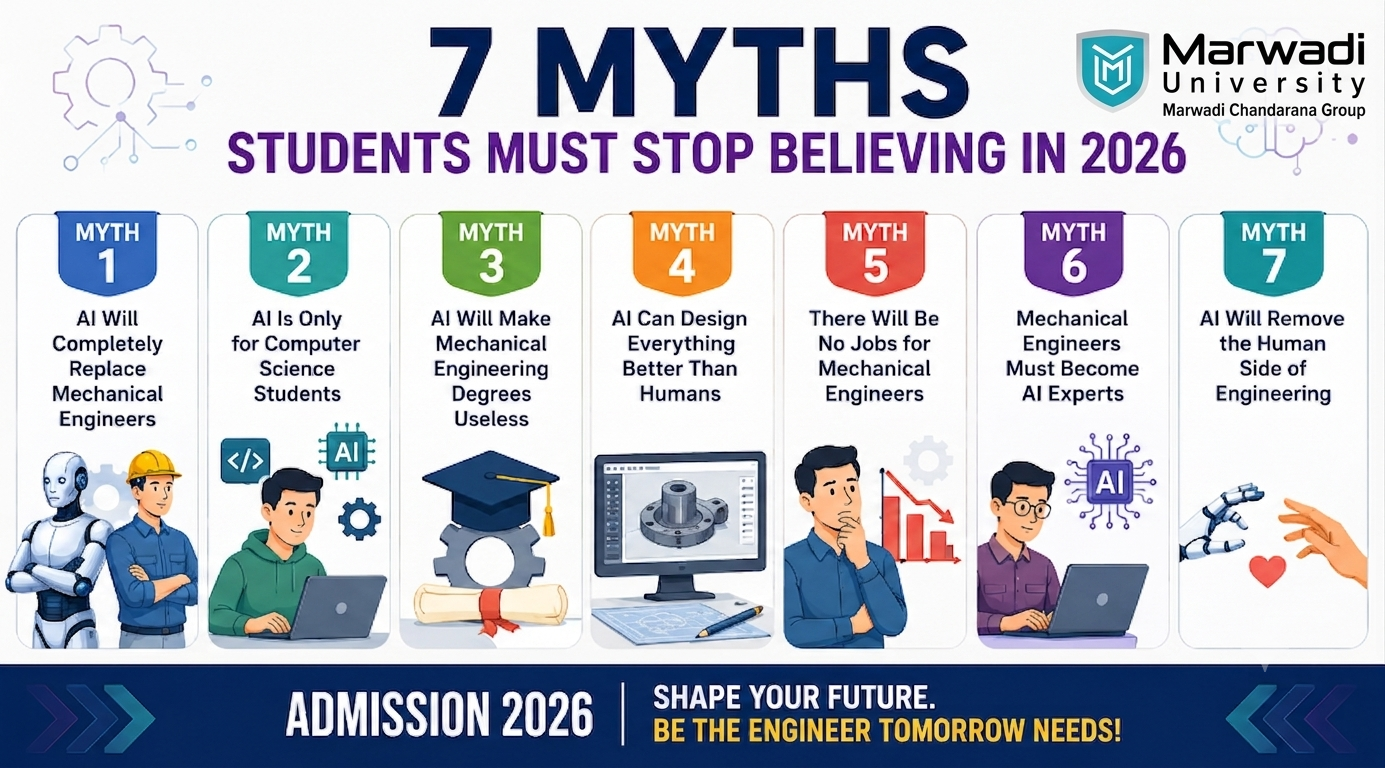
Myth 1: AI Will Completely Replace Mechanical Engineers
Reality: AI can automate repetitive tasks, but it cannot independently replace the complete role of a mechanical engineer. Engineers still need expertise in:
- Physics and mechanics
- Materials and thermodynamics
- Manufacturing processes
- Safety and quality standards
- Real-world engineering constraints
AI can generate design suggestions and analyse large amounts of data. However, human engineers must decide whether a solution is practical, safe, affordable, and suitable for real-world use.
This means the AI impact on mechanical engineering jobs is more likely to change job responsibilities than eliminate the profession. Future engineers will increasingly work alongside AI systems, combining engineering knowledge with technology, creativity, and human decision-making.
Myth 2: AI Is Only for Computer Science Students
Reality: Mechanical engineering students do not need to become professional programmers to benefit from AI. AI is already being used in areas such as:
- Design optimisation
- Predictive maintenance
- Robotics
- Smart manufacturing
- Engineering simulation
- Quality control
Learning basic programming, data analysis, machine learning concepts, and automation can give students an advantage. These are becoming valuable AI skills for mechanical engineers.
The most successful professionals will not necessarily be those with the deepest knowledge of AI theory. Instead, they will be engineers who understand how to apply AI to solve mechanical and industrial problems. This combination of domain knowledge and digital skills is creating new career opportunities across engineering industries.
Myth 3: AI Will Make Mechanical Engineering Degrees Useless
Reality: A strong engineering foundation is becoming more valuable, not less. AI tools can provide calculations, simulations, and design suggestions, but they still require accurate engineering inputs and professional interpretation.
Students with a strong understanding of the following can use AI more effectively:
- Mechanics
- Materials
- Thermodynamics
- Fluid dynamics
- Manufacturing
This is why mechanical engineering in the AI era requires both fundamental knowledge and technological adaptability. A degree helps students understand how engineering systems work, while AI becomes a powerful tool for improving those systems.
The future will favour engineers who combine strong fundamentals with continuous learning and technological awareness.
Myth 4: AI Can Design Everything Better Than Humans
Reality: AI can explore thousands of design possibilities quickly, but the most technically optimised design is not always the best real-world solution.
A successful design must also consider:
- Cost
- Manufacturing limitations
- Sustainability
- User needs
- Regulations
- Safety
- Maintenance
Mechanical engineers bring context and professional judgement to the design process. They understand practical challenges that may not be visible in a dataset.
Modern AI tools for mechanical engineers can support generative design, simulation, CAD workflows, and optimisation. However, engineers still need to define the problem correctly and evaluate the results. AI can create options, but human expertise remains essential for selecting and implementing the right solution.
Myth 5: There Will Be No Jobs for Mechanical Engineers
Reality: The job market is changing, but new technologies are also creating new roles and opportunities. Mechanical engineers are increasingly needed in industries such as:
- Electric vehicles
- Robotics
- Automation
- Renewable energy
- Aerospace
- Smart manufacturing
- Advanced product development
The future of mechanical engineering is becoming more interdisciplinary. Engineers may work with sensors, data, AI models, digital twins, and automated production systems.
Some repetitive tasks may become automated. However, this can allow engineers to focus more on:
- Innovation
- Problem-solving
- System design
- Product development
- Strategic decision-making
Students who develop both core engineering knowledge and digital skills can position themselves strongly for emerging opportunities.
Myth 6: Mechanical Engineers Must Become AI Experts
Reality: Not every mechanical engineer needs to become a machine learning researcher. The level of AI knowledge required depends on a person’s career path.
For example:
- Design engineers may benefit from AI-assisted CAD and generative design.
- Manufacturing engineers may need knowledge of predictive maintenance and industrial automation.
- Robotics engineers may require deeper programming and machine learning skills.
The key is to develop relevant skills based on your career goals. Understanding how AI works, where it can be applied, and how to evaluate its output is often more important than mastering every technical detail.
This balanced approach can make a mechanical engineering career in 2026 more flexible, adaptable, and future-ready.
Myth 7: AI Will Remove the Human Side of Engineering
Reality: Engineering is not only about calculations and technical output. It also involves:
- Teamwork
- Communication
- Ethics
- Leadership
- Creativity
- Understanding human needs
Machines can process information quickly, but engineers must consider how technology affects people, businesses, communities, and the environment.
The debate around AI replacing mechanical engineers often focuses only on automation. However, future engineering will depend heavily on collaboration between humans and intelligent systems.
Engineers will need to:
- Ask better questions
- Make responsible decisions
- Communicate complex ideas clearly
- Solve problems without simple answers
- Consider the wider impact of technology
AI may change engineering work, but human judgement will continue to shape how technology is designed, developed, and used.
Final Thoughts
So, will AI replace mechanical engineers? The short answer is unlikely to be a complete replacement. Instead, AI is expected to transform the way mechanical engineers design, analyse, manufacture, and solve problems.
The future belongs to engineers who are willing to adapt. Students entering the field should focus on building strong fundamentals while learning relevant digital technologies. Knowledge of AI, automation, data, simulation, robotics, and smart manufacturing can help engineers stay competitive in a changing job market.
The future of mechanical engineering with AI is not about choosing between traditional engineering and technology. It is about combining both. Students who understand engineering principles and know how to use modern tools can contribute to industries that are becoming smarter and more automated.
The AI impact on mechanical engineering jobs will create challenges, but it will also create opportunities for professionals with the right skills and mindset. Rather than fearing AI, aspiring engineers should learn how to work with it.
For students planning their next academic step, mechanical engineering remains a strong foundation for building a career in design, manufacturing, automotive technology, robotics, aerospace, energy, automation, and emerging technologies. The engineers of tomorrow will not compete with AI alone. They will know how to use it to become better engineers.
FAQs
1. Will AI replace mechanical engineers?
No. AI is more likely to automate repetitive tasks and support engineers than completely replace mechanical engineers.
2. How is AI used in mechanical engineering?
AI is used in design optimisation, predictive maintenance, robotics, simulation, manufacturing, quality control, and data analysis.
3. What AI skills should mechanical engineers learn?
Mechanical engineers can learn basic programming, data analysis, machine learning fundamentals, automation, AI-assisted design, and simulation tools.
4. Is mechanical engineering a good career in 2026?
Yes. Mechanical engineering continues to offer opportunities in EVs, robotics, aerospace, automation, manufacturing, renewable energy, and smart technologies.
5. What is the future of mechanical engineering?
The future will combine core mechanical engineering with AI, automation, robotics, digital twins, advanced manufacturing, and other emerging technologies.