Is BTech Chemical Engineering a Good Career in 2026? Scope, Jobs & Salary Explained
If you are choosing an engineering branch after Class 12, you may be asking: is Chemical Engineering still a good career in 2026? The short answer is yes, especially for students interested in chemistry, mathematics, process design, manufacturing, energy, and technology. A BTech Chemical Engineering degree can lead to careers across chemicals, pharmaceuticals, petroleum, food processing, energy, environmental technology, and other process-driven industries.
Chemical engineers do more than work with chemicals. They design and improve industrial processes, manage production systems, reduce waste, improve safety, and help companies make products efficiently. As industries focus more on sustainability, clean energy, advanced materials, and resource efficiency, the role is also evolving.
This guide explains the BTech Chemical Engineering career scope, job roles, salary expectations, skills, and future opportunities in India. It also looks at why the course can be a practical choice for students who want a combination of science, engineering, problem-solving, and industry exposure.
By understanding the course and its career paths, you can make a more informed decision about whether Chemical Engineering matches your interests, strengths, and long-term goals. It can also provide a foundation for higher studies, research, management, or specialised technical careers as your experience grows in different industries.
What is BTech Chemical Engineering?
BTech Chemical Engineering is a four-year undergraduate engineering programme that teaches students how to convert raw materials into useful products safely, efficiently, and economically. It combines chemistry and mathematics with physics, process engineering, materials, equipment design, and industrial operations.
Students learn how industrial processes work, from handling raw materials to separation, reaction, heat transfer, fluid flow, and final product processing. The curriculum can also introduce areas such as biochemical engineering and process design. Marwadi University’s published Chemical Engineering syllabus, for example, includes topics such as fermentation processes, bioprocess engineering, mass transfer, and distillation-column design.
Key areas generally covered include:
- Chemical reaction engineering
- Thermodynamics
- Heat and mass transfer
- Fluid mechanics
- Process control
- Process equipment design
- Industrial chemistry
- Environmental and safety practices
- Process simulation and optimisation
The degree is useful for students who enjoy applying scientific concepts to real-world industrial problems. Instead of focusing only on laboratory chemistry, Chemical Engineering looks at how processes can be designed, scaled, controlled, and improved in large industrial settings.
In simple terms, chemical engineers help industries make products better, safer, faster, and more sustainably. That makes the degree relevant to several manufacturing and technology-driven sectors today.
What Skills Will You Learn in BTech Chemical Engineering?
A BTech Chemical Engineering programme develops both technical and practical skills that can support different career paths. Students typically build skills in:
- Problem-solving and analytical thinking
- Process design and optimisation
- Mathematics, chemistry, and engineering analysis
- Laboratory and experimental techniques
- Process simulation and data interpretation
- Safety and risk awareness
- Communication and teamwork
- Sustainable and resource-efficient thinking
Students can also strengthen digital skills such as simulation software, data analysis, and process-control tools. These skills can help graduates adapt to modern manufacturing, energy, pharmaceutical, and environmental applications. Internships and hands-on projects can further improve industry readiness.
What is the Scope of Chemical Engineering in India?
The BTech Chemical Engineering career scope in India extends beyond traditional chemical plants. Graduates can work in production, process design, quality, safety, research, operations, and technical services. The Chemical Engineering career scope in 2026 is also being shaped by sustainability, cleaner production, advanced materials, energy transition, and process automation.
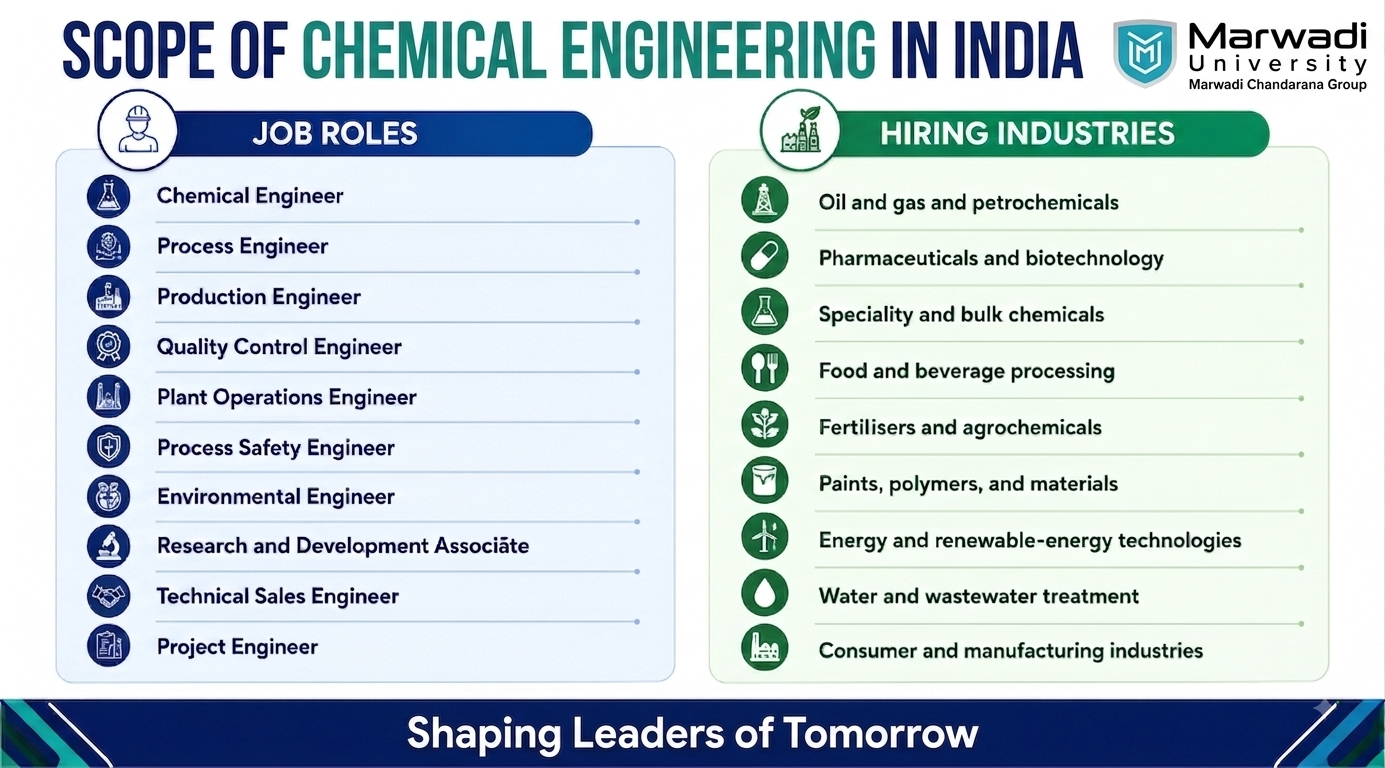
Job roles include:
- Chemical Engineer
- Process Engineer
- Production Engineer
- Quality Control Engineer
- Plant Operations Engineer
- Process Safety Engineer
- Environmental Engineer
- Research and Development Associate
- Technical Sales Engineer
- Project Engineer
Hiring industries include:
- Oil and gas and petrochemicals
- Pharmaceuticals and biotechnology
- Speciality and bulk chemicals
- Food and beverage processing
- Fertilisers and agrochemicals
- Paints, polymers, and materials
- Energy and renewable-energy technologies
- Water and wastewater treatment
- Consumer and manufacturing industries
These areas create BTech Chemical Engineering job opportunities for graduates with relevant technical knowledge and practical experience. Students can also move into consulting, technical sales, analytics, or management after gaining relevant skills.
The Chemical Engineering future scope is especially relevant for students exploring green hydrogen, carbon management, sustainable manufacturing, advanced materials, and energy-efficient processes. Career growth depends on skills, internships, specialisation, employer, location, and experience.
What is the Salary of a Chemical Engineer in India?
The BTech Chemical Engineering salary in India varies by role, employer, location, skills, and experience.
A salary range can be viewed as:
- Freshers: around ₹3-6 LPA
- Early-career professionals: around ₹5-10 LPA
- Experienced professionals: ₹10 LPA and above
These are market ranges, not guaranteed salaries. A Chemical Engineer salary in India can be higher in specialised roles, leading companies, or senior positions.
Why Choose Marwadi University for BTech Chemical Engineering?
Choosing a university matters because Chemical Engineering is practical and industry-oriented. Marwadi University offers Chemical Engineering as a four-year BTech programme in its Faculty of Engineering and Technology.
The university has NAAC A+ accreditation, NBA Tier-1 programs, a 353 QS Asia rank, a Top 200-300 NIRF rank, and is awarded as a Centre of Excellence by the government of Gujarat.
Why consider Marwadi University?
- Hands-on learning: Practical, project-based learning
- Industry relevance: Industry-aligned curriculum and research
- Technical curriculum: Includes process design, biochemical engineering, optimisation
- Research exposure: Encourages innovation and applied projects
- Skill development: Focus on knowledge, skills, and soft skills
- University ecosystem: NAAC A+ institution with strong engineering infrastructure
For students seeking BTech Chemical Engineering jobs in India, this combination of learning, practical exposure, projects, and career preparation can help build a foundation for entering the process and manufacturing sectors.
Final Thoughts
So, is Chemical Engineering a good career in 2026? For students who enjoy chemistry, mathematics, problem-solving, manufacturing, and technology, it can be a rewarding and versatile engineering choice. Graduates can explore careers in pharmaceuticals, petrochemicals, energy, food processing, speciality chemicals, environmental services, materials, and process industries.
The BTech Chemical Engineering career scope can expand as industries adopt automation, cleaner processes, renewable energy, and sustainable production. Green hydrogen, advanced materials, carbon management, and resource efficiency can create new applications.
A degree alone does not guarantee a high salary or a job. Internships, projects, software skills, communication, problem-solving, safety awareness, and industry exposure can improve employability. Specialisation can also improve long-term opportunities.
When comparing engineering branches, focus on your interests rather than popularity. A BTech Chemical Engineering programme can be a strong fit if you want to understand how science becomes large-scale industrial solutions.
With the right skills, practical exposure, and continuous learning, Chemical Engineering can offer a meaningful career path in 2026 and beyond.
FAQs
1. Is BTech Chemical Engineering a good career in 2
Yes. BTech Chemical Engineering offers careers in pharmaceuticals, chemicals, energy, petrochemicals, food processing, materials, and environmental industries.
2. What is the scope of Chemical Engineering in India?
Scope includes process engineering, production, quality control, plant operations, research, safety, environmental engineering, and technical sales.
3. What is the salary of a Chemical Engineer in India?
Freshers typically earn ₹3–6 LPA, while experienced professionals can earn ₹10 LPA or more.
4. What jobs can I get after BTech Chemical Engineering?
Roles include Chemical Engineer, Process Engineer, Production Engineer, Quality Engineer, Plant Operations Engineer, Project Engineer, and R&D Associate.
5. What is the future scope of Chemical Engineering?
Future scope includes sustainable manufacturing, green hydrogen, advanced materials, renewable energy, carbon management, and process optimisation.