10 Emerging Technologies in Civil Engineering Transforming the Industry in 2026 and Beyond

Civil engineering is no longer limited to designing buildings, roads, bridges, and infrastructure using traditional methods. Today, technology is changing how civil engineers plan, design, construct, monitor, and maintain the physical world. From artificial intelligence and digital models to drones, robotics and smart sensors, the industry is becoming more connected and data-driven.
The rise of emerging technologies in civil engineering is creating new possibilities for faster construction, better decision-making, improved safety and more efficient infrastructure management. These innovations are not replacing civil engineers. Instead, they are changing the skills and tools that future engineers may need to use.
Many of the new technologies in civil engineering are helping professionals solve challenges that were once difficult to manage manually. Engineers can now analyse large amounts of data, create detailed digital models, monitor structures remotely and identify potential issues before they become major problems.
As cities expand and infrastructure needs become more complex, technology will play an even bigger role in the profession. Understanding the latest technologies in civil engineering can therefore help students prepare for a field that is evolving rapidly.
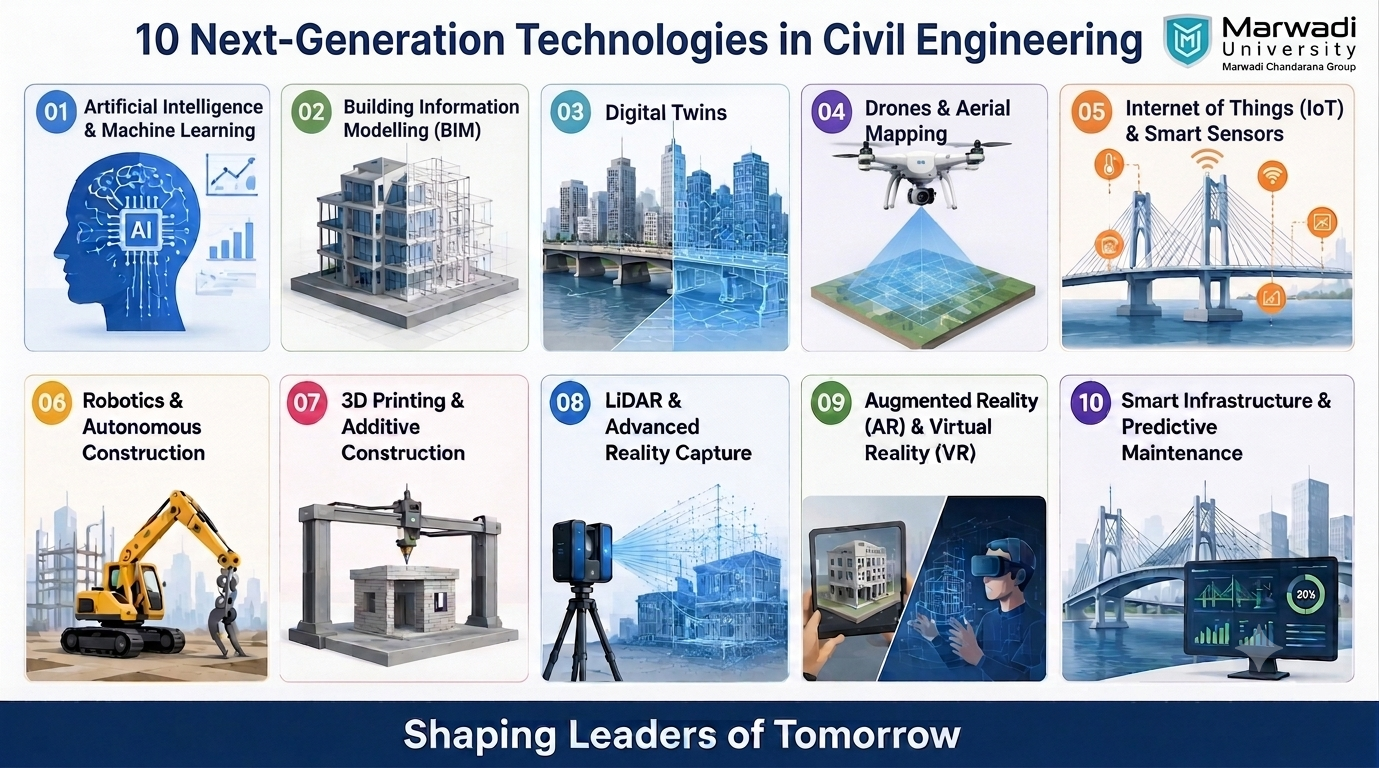
10 Next-Generation Technologies That Are Redefining Civil Engineering
1. Artificial Intelligence & Machine Learning
AI in civil engineering is transforming how engineers analyse information and make decisions. Artificial intelligence and machine learning can process large volumes of project, design and construction data faster than traditional manual methods.
AI can support engineers in areas such as:
- Design optimisation
- Construction planning
- Risk analysis
- Project scheduling
- Predictive maintenance
Machine learning systems can identify patterns in historical and real-time data, helping professionals make more informed decisions. AI can also support quality control and site monitoring through computer vision and automated data analysis.
However, AI is best seen as a powerful engineering tool rather than a replacement for human expertise. Civil engineers still need technical knowledge, practical understanding, and professional judgement to interpret results and make responsible decisions.
2. Building Information Modelling (BIM)
BIM in civil engineering has changed the way projects are planned and visualised. Instead of relying only on separate drawings and documents, BIM brings different project information into an integrated digital model.
BIM can support:
- Better design coordination
- Improved collaboration
- Clash detection
- Project visualisation
- More organised project information
Architects, engineers and construction professionals can work with shared digital information throughout different stages of a project. This can help identify potential design conflicts before construction begins.
As infrastructure projects become more complex, BIM is becoming an important part of modern engineering workflows. It also creates a foundation for other digital technologies, including data-driven construction and digital twins.
3. Digital Twins
A digital twin in civil engineering is a digital representation of a physical asset, such as a bridge, building, or other infrastructure system. It can be connected with data from sensors and other sources to reflect the condition or behaviour of the real asset.
Digital twins can help with:
- Infrastructure monitoring
- Performance analysis
- Simulation
- Maintenance planning
- Lifecycle management
For example, engineers may use data from a physical structure to monitor changes and identify potential maintenance requirements. This creates opportunities for more proactive infrastructure management.
As digital systems and sensor technologies continue to develop, digital twins could become an important part of the future of civil engineering technology, especially for smart cities and large infrastructure projects.
4. Drones & Aerial Mapping
Drones are making surveying, mapping, and infrastructure inspection faster and more efficient. They can capture aerial images and collect data from locations that may be difficult, time-consuming, or unsafe to access manually.
Drones can support civil engineering through:
- Land surveying
- Site monitoring
- Progress tracking
- Bridge inspection
- Aerial mapping
The information collected by drones can be combined with mapping software and other digital tools to create detailed site models.
These latest technologies in civil engineering are particularly useful for large construction sites and infrastructure projects. Instead of depending only on manual inspections, engineers can gain a broader and more detailed view of project conditions.
5. Internet of Things (IoT) & Smart Sensors
The IoT in civil engineering connects physical infrastructure with digital systems through sensors and connected devices. These sensors can collect real-time information about factors such as movement, temperature, vibration, and structural conditions.
IoT technology can support:
- Structural health monitoring
- Traffic management
- Environmental monitoring
- Equipment tracking
- Infrastructure performance analysis
For example, sensors installed on a bridge may provide engineers with useful information about its behaviour over time.
By collecting continuous data, connected infrastructure can become easier to monitor and manage. IoT is therefore an important part of the growing shift towards intelligent and responsive infrastructure systems.
6. Robotics & Autonomous Construction
The use of robotics in construction is gradually changing how certain physical and repetitive tasks are performed. Robots and autonomous machines can assist with activities that require precision, consistency, or operation in challenging environments.
Potential applications include:
- Automated construction tasks
- Robotic inspection
- Autonomous equipment
- Material handling
- Site monitoring
Autonomous machinery may also improve efficiency in large-scale construction projects by supporting repetitive operations.
Rather than eliminating the role of engineers, robotics is likely to create greater demand for professionals who understand both engineering principles and technology. Future civil engineers may increasingly work alongside automated systems while focusing on planning, supervision, design, and complex problem-solving.
7. 3D Printing & Additive Construction
3D printing in construction is introducing a new approach to creating buildings and structural components. Instead of using only conventional construction methods, automated systems can place material layer by layer based on a digital design.
This technology may offer benefits such as:
- Faster construction processes
- Reduced material waste
- Greater design flexibility
- Automated fabrication
- New construction possibilities
Additive construction is still developing, but it demonstrates how digital design and automation can work together in the built environment.
As technology advances, 3D printing could become more relevant for specialised construction projects, housing solutions and customised structural components. It represents one of the most interesting new technologies in civil engineering for students to watch.
8. LiDAR & Advanced Reality Capture
LiDAR and advanced reality capture technologies are improving how engineers measure and understand physical environments. LiDAR uses laser-based scanning to create detailed three-dimensional information about objects, structures, and landscapes.
These technologies can support:
- Topographic surveying
- Infrastructure inspection
- 3D modelling
- Site documentation
- Existing condition assessment
Reality capture can provide highly detailed information that can later be used in digital models and project planning.
For civil engineers, this means faster access to accurate spatial data. When combined with technologies such as BIM and drones, LiDAR can help create a more complete digital understanding of construction sites and existing infrastructure.
9. Augmented Reality (AR) & Virtual Reality (VR)
AR and VR are changing how engineering projects are visualised and understood. Virtual reality can create immersive digital environments, while augmented reality can overlay digital information onto the physical world.
These tools can support:
- Design visualisation
- Engineering education
- Safety training
- Project collaboration
- On-site information access
For example, engineers and project teams may be able to visualise a design before construction or compare digital information with real-world conditions on site.
As smart construction technology continues to develop, immersive tools could improve communication between engineers, architects, contractors and other stakeholders. They can also help students understand complex structures and construction processes in more interactive ways.
10. Smart Infrastructure & Predictive Maintenance
Smart infrastructure brings together sensors, data analytics, AI, and connected technologies to improve the management of physical assets. Instead of waiting for visible damage or system failure, engineers can increasingly use data to identify potential problems earlier.
Smart systems can support:
- Real-time infrastructure monitoring
- Early fault detection
- Performance analysis
- Predictive maintenance
- Better resource management
This approach can help shift infrastructure management from reactive maintenance to more proactive decision-making.
The combination of AI, IoT, digital twins, and sensors represents a major direction in the future of civil engineering technology. Tomorrow’s infrastructure may not simply be built; it may continuously generate information that helps engineers understand how it performs.
Final Thoughts
The future of civil engineering will continue to be shaped by innovation, but the profession’s core purpose will remain the same: solving real-world problems and building infrastructure that supports society.
The growing use of emerging technologies in civil engineering shows that future engineers may need a combination of traditional engineering knowledge and digital skills. Understanding AI, data, automation, BIM and connected infrastructure can help students prepare for a changing professional environment.
The most important lesson is simple: technology is becoming an extension of engineering capability. Civil engineers who understand how to combine technical expertise with new digital tools may be better prepared for the opportunities ahead.
FAQs
1. What are the emerging technologies in civil engineering?
Major emerging technologies in civil engineering include AI, BIM, digital twins, drones, IoT, robotics, 3D printing, LiDAR, AR/VR and smart infrastructure systems.
2. How is AI changing civil engineering?
AI in civil engineering can support design optimisation, data analysis, construction planning, site monitoring and predictive maintenance.
3. What is a digital twin in civil engineering?
A digital twin in civil engineering is a digital representation of a physical asset that can use real-world data for monitoring, analysis and maintenance planning.
4. What technology should future civil engineers learn?
Future civil engineers can benefit from learning technologies such as BIM, AI, data analysis, IoT, digital modelling and smart construction technology alongside core engineering concepts.
5. Will technology replace civil engineers?
No. Technology is more likely to transform the role of civil engineers by automating certain tasks and providing better data, while engineers continue to apply technical knowledge, judgement and problem-solving skills.