What Are Hybrid Careers in ICT? Top 10 Future-Ready Jobs
The technology industry is changing faster than ever. Companies are no longer looking for professionals who excel in just one area. Instead, they want people who can combine multiple skills to solve complex business problems. This is where Hybrid careers in ICT are becoming the future of the technology workforce.
From artificial intelligence and cybersecurity to cloud computing and data analytics, modern professionals are expected to understand different technologies and work across teams. These careers are exciting because they allow graduates to explore diverse opportunities instead of following a traditional job path.
Whether you are planning to pursue a BTech in Information and Communication Technology (ICT) or are simply curious about the future of technology, understanding these evolving roles can help you make smarter career choices. Many of today’s fastest-growing jobs didn’t even exist a decade ago, and the demand for professionals with cross-functional expertise continues to grow.
This blog explores Hybrid careers in ICT, the skills they require, and the opportunities they offer. If you’re looking for a career that combines innovation, creativity, and problem-solving, these emerging roles could be the perfect fit for your future.
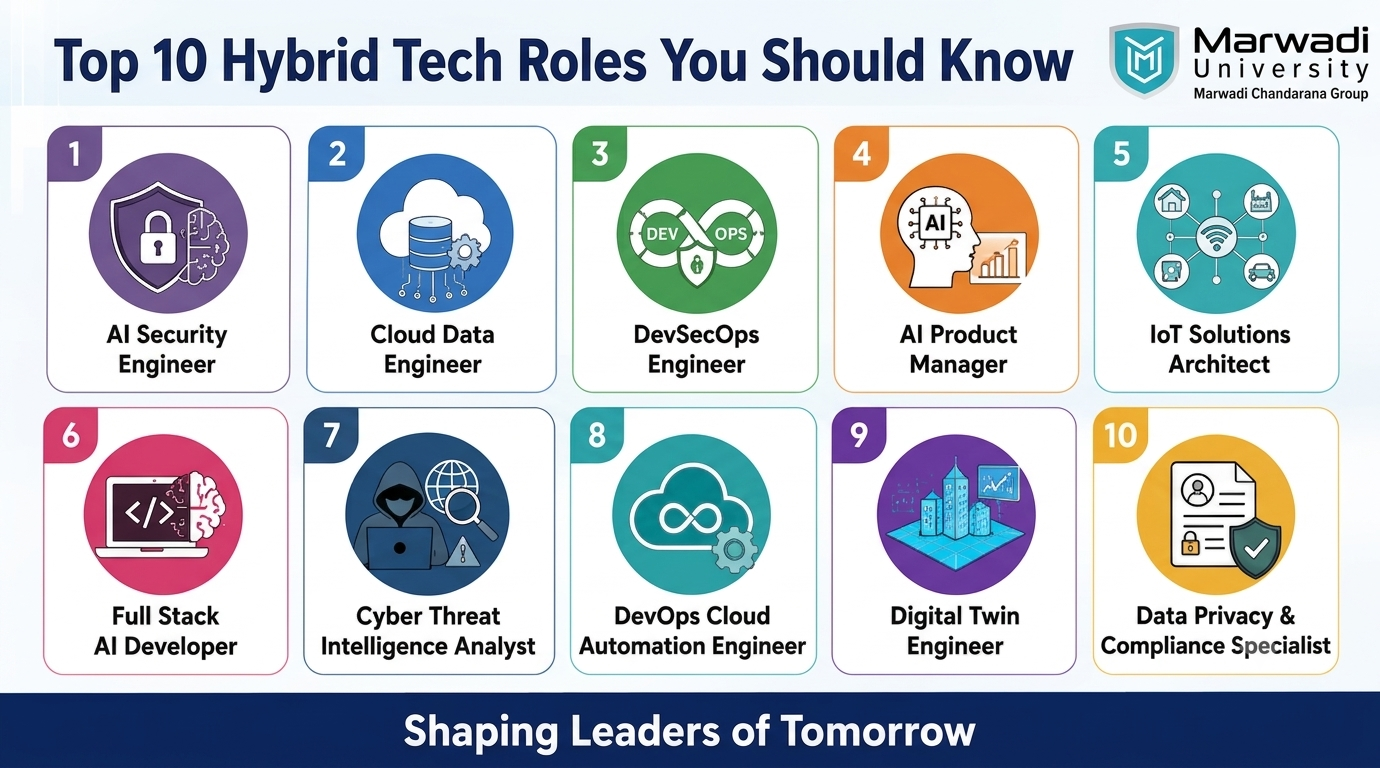
What Are the Top 10 Hybrid Tech Roles That You Should Know?
Technology is becoming more interconnected every year. As a result, ICT careers in 2026 are no longer limited to software development, networking, or system administration. Here are some exciting hybrid roles shaping the future.
1. AI Security Engineer
Artificial intelligence is transforming industries, but it also creates new security challenges. AI Security Engineers combine machine learning, cybersecurity, and risk management to protect AI-powered systems from cyber threats.
They ensure AI models remain secure, reliable, and free from attacks such as data poisoning or model manipulation. As organisations increasingly adopt AI, this role is becoming one of the most valuable ICT careers in 2026, offering opportunities across healthcare, finance, e-commerce, and government sectors.
What they do:
- Secure AI applications and machine learning models
- Detect AI-powered cyber threats and vulnerabilities
- Develop intelligent security solutions
- Monitor AI systems for unusual activities
2. Cloud Data Engineer
Modern businesses generate enormous amounts of data every day, making Cloud Data Engineers essential for managing and analysing information efficiently. These professionals build scalable data pipelines, optimise cloud storage, and ensure data is available for analytics and business decision-making.
With organisations moving their operations to cloud platforms, this role is among the fastest-growing cloud computing and data science jobs and offers excellent career growth across multiple industries.
Skills required:
- Cloud platforms such as AWS, Azure, or Google Cloud
- SQL and database management
- Data pipelines and ETL processes
- Python and big data technologies
3. DevSecOps Engineer
Software development today requires security at every stage rather than after deployment. DevSecOps Engineers integrate cybersecurity practices into development and operations, ensuring applications remain secure throughout the software lifecycle.
By combining automation, cloud infrastructure, software engineering, and security, they help organisations reduce vulnerabilities and accelerate product delivery. This position is one of the fastest-growing emerging ICT jobs, especially as businesses adopt cloud-native technologies.
Responsibilities:
- Secure software deployment processes
- Automate security testing and compliance
- Manage cloud infrastructure securely
- Continuously monitor systems for threats
4. AI Product Manager
AI Product Managers combine technical knowledge with business strategy to create successful AI-powered products. Instead of developing algorithms, they work closely with engineers, designers, and stakeholders to identify customer needs and deliver practical AI solutions.
They balance innovation with business goals, making this role ideal for professionals who enjoy technology and leadership. As AI adoption grows, organisations increasingly seek managers who can bridge technical and business teams effectively.
Skills required:
- Strong technical understanding of AI concepts
- Business and market strategy skills
- Excellent communication abilities
- Leadership and decision-making capabilities
5. IoT Solutions Architect
The Internet of Things (IoT) connects devices, machines, and systems to create smarter homes, industries, and cities. IoT Solutions Architects design these connected ecosystems by combining networking, embedded systems, cloud computing, cybersecurity, and data analytics.
They ensure devices communicate securely while delivering real-time insights for businesses. As industries embrace digital transformation, this role is becoming one of the most exciting future careers in information and communication technology.
Key responsibilities:
- Design secure IoT architectures
- Integrate cloud and connected devices
- Optimise communication between systems
- Ensure data security and scalability
6. Full Stack AI Developer
The traditional full stack developer career is evolving with artificial intelligence. Today’s developers not only build websites and applications but also integrate AI features such as chatbots, recommendation engines, automation tools, and predictive analytics.
They work across front-end, back-end, databases, APIs, and AI frameworks to create intelligent digital experiences. Professionals with expertise in both software development and AI are increasingly valued by startups, technology companies, and global enterprises.
Core skills include:
- Front-end development
- Back-end programming
- AI model integration
- API development
- Database management
7. Cyber Threat Intelligence Analyst
Cyber Threat Intelligence Analysts help organisations stay ahead of cybercriminals by identifying potential threats before they become attacks. They combine cybersecurity, artificial intelligence, digital forensics, and data analytics to monitor security risks and recommend preventive measures.
Their insights help businesses strengthen digital security and reduce financial losses. As cyber threats continue to evolve, this role has become one of the most promising AI and cybersecurity careers available today.
Key responsibilities:
- Conduct threat analysis
- Perform risk assessments
- Prepare security intelligence reports
- Support incident response teams
8. DevOps Cloud Automation Engineer
Businesses rely on fast and reliable software delivery, making automation a top priority. Professionals following the DevOps engineer career path design automated workflows that simplify software deployment, infrastructure management, and cloud operations.
They use tools to improve efficiency, minimise downtime, and ensure applications perform consistently across different environments. Their expertise allows organisations to deliver updates quickly while maintaining system reliability and security.
Key responsibilities:
- Automate software deployment
- Manage cloud infrastructure
- Monitor application performance
- Improve system reliability and scalability
9. Digital Twin Engineer
Digital Twin Engineers develop virtual replicas of physical machines, factories, buildings, or entire systems using AI, IoT, cloud computing, and simulation technologies. These digital models allow organisations to monitor performance, predict failures, and improve operational efficiency without disrupting real-world processes.
Industries such as manufacturing, healthcare, transportation, and smart cities increasingly depend on these professionals, making this role one of today’s most innovative high-demand tech careers.
What they work on:
- Virtual system modelling
- AI-powered simulations
- Performance monitoring
- Predictive maintenance solutions
10. Data Privacy & Compliance Specialist
As businesses collect more digital information, protecting customer data has become a legal and ethical responsibility. Data Privacy & Compliance Specialists ensure organisations follow privacy regulations while implementing secure data management practices.
They collaborate with cybersecurity teams, legal experts, and cloud professionals to minimise risks and maintain compliance with global standards. This position perfectly represents today’s growing demand for multi-disciplinary technology careers that combine technology, governance, and business knowledge.
Key responsibilities:
- Ensure regulatory compliance
- Protect sensitive customer information
- Develop data privacy policies
- Conduct security and compliance audits
What Skills Do You Need to Succeed in Hybrid ICT Careers?
While every role is different, employers consistently look for the following skills required for ICT careers:
- Programming fundamentals
- Artificial Intelligence basics
- Cloud computing
- Cybersecurity awareness
- Data analytics
- Networking concepts
- Problem-solving skills
- Communication and teamwork
- Adaptability
- Continuous learning mindset
Students who develop both technical expertise and soft skills will be better prepared for the future technology workforce.
Final Thoughts
The future of technology belongs to professionals who are willing to learn beyond a single discipline. As industries continue to adopt artificial intelligence, cloud computing, automation, and cybersecurity, employers are increasingly looking for people who can connect multiple technologies and solve real-world challenges.
Rather than limiting yourself to a single specialisation, consider developing a combination of technical and analytical skills. Explore projects, internships, certifications, and collaborative learning experiences that expose you to different areas of technology. These experiences not only strengthen your resume but also prepare you for rapidly changing workplace demands.
The good news is that Marwadi University has curricula that match industry expectations, giving students more opportunities to gain practical, interdisciplinary knowledge. Whether your interest lies in AI, cloud computing, cybersecurity, software development, or data science, combining these skills can unlock exciting career opportunities across industries.
The university has NAAC A+ grade, NBA Tier-1 programs, 353 QS Asia rank, a Top 200-300 NIRF ranking, and is awarded as a Centre of Excellence by the Government of Gujarat.
As businesses continue to innovate, Hybrid careers in ICT will become even more valuable. Graduates who embrace continuous learning, adaptability, and cross-functional expertise will be well-positioned to succeed in tomorrow’s digital economy. The future doesn’t belong to professionals who fit into one box; it belongs to those who confidently bridge many.
FAQs
1. What are Hybrid careers in ICT?
Hybrid careers in ICT combine expertise across multiple technology domains, including AI, cybersecurity, cloud computing, software development, and data analytics.
2. Why are hybrid ICT roles becoming popular?
Businesses need professionals who can work across technologies, solve complex problems, and adapt to rapid digital transformation.
3. Which hybrid ICT career has the highest demand?
Roles like AI Security Engineer, DevSecOps Engineer, Cloud Data Engineer, and Full Stack AI Developer are among today’s fastest-growing technology careers.
4. What skills are required for hybrid ICT careers?
Key skills include programming, cloud computing, AI fundamentals, cybersecurity, data analytics, communication, and problem-solving.
5. Can ICT students pursue hybrid careers after graduation?
Yes. ICT graduates are well-equipped to enter hybrid technology roles by building practical skills through projects, internships, certifications, and continuous learning.