10 Real-World Applications of Future Technologies in Chemical Engineering
Chemical engineering is changing fast. Today, engineers are not only designing chemical processes; they are also using artificial intelligence, advanced materials, clean energy systems, automation, and data-driven tools. These changes are creating new possibilities across healthcare, energy, manufacturing, food, and environmental protection. Understanding the future technologies in chemical engineering can help students see where the field is heading and what skills will matter tomorrow.
From AI-powered process optimisation to green hydrogen and smart manufacturing, technology is making chemical plants safer, more efficient, and more sustainable. The future of chemical engineering will increasingly connect traditional engineering knowledge with computing, biotechnology, energy science, and environmental solutions. This shift also creates exciting career opportunities for students who build both technical and digital skills.
In this blog, we explore 10 future technologies in chemical engineering that are transforming industries in the AI era. We will look at how these technologies work, where they are being used, and why they matter for the next generation of chemical engineers. It is a shift worth understanding right now.
10 Real-World Applications in Chemical Engineering
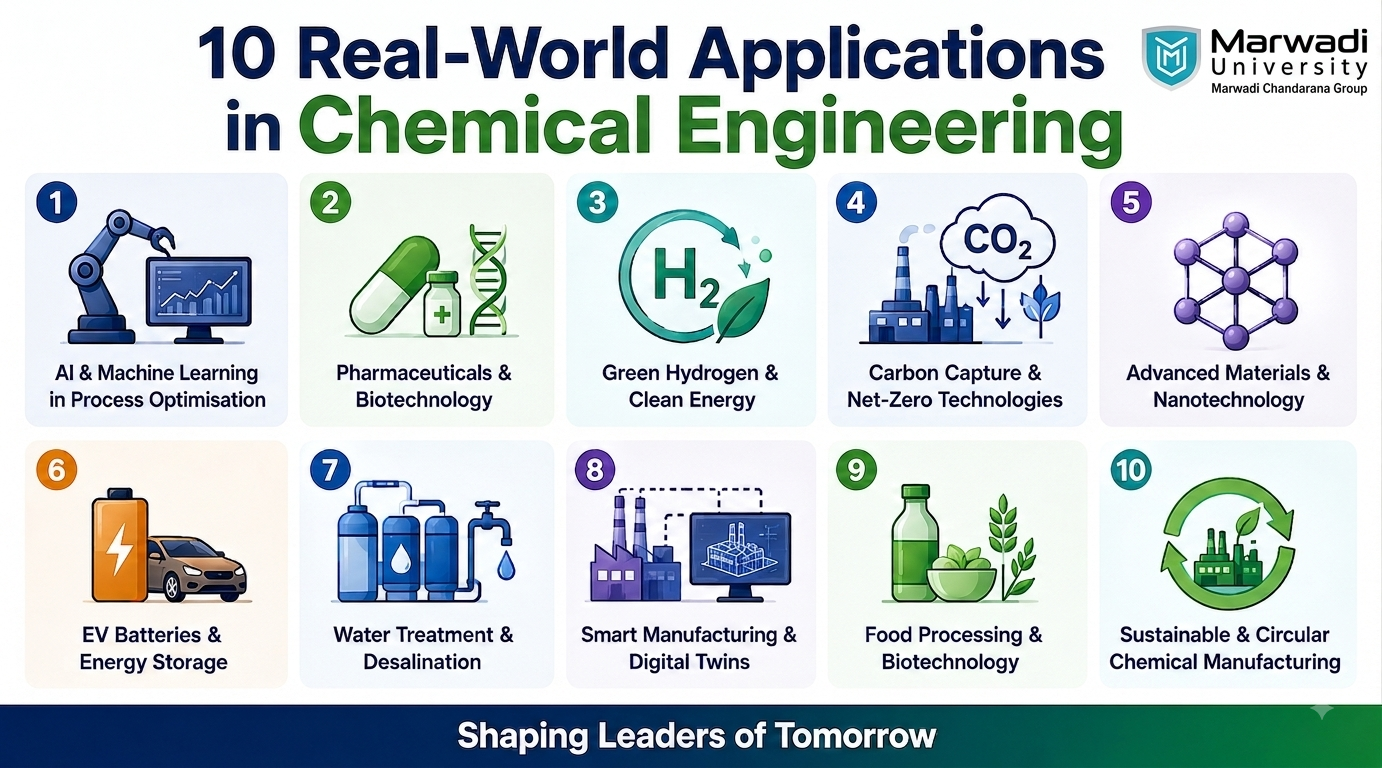
1. AI & Machine Learning in Process Optimisation
AI and machine learning are helping chemical engineers analyse large amounts of process data and make faster decisions. AI in chemical engineering can identify patterns, predict equipment behaviour, detect process problems, and improve operating conditions. Instead of relying only on manual calculations, engineers can use data-driven models to optimise temperature, pressure, flow rates, and energy use.
- Predicts process performance
- Detects abnormal conditions
- Improves energy efficiency
- Supports faster decision-making
AI and machine learning in chemical engineering can therefore improve productivity while supporting safer and more reliable operations. These tools also help engineers test different operating strategies before applying them to a real plant.
2. Pharmaceuticals & Biotechnology
The pharmaceutical and biotechnology industries are becoming more data-driven, creating new opportunities for chemical engineers. Artificial intelligence in chemical engineering can help optimise drug manufacturing, analyse biological processes, and improve production quality. Machine learning can also support faster discovery of promising molecules and help researchers understand complex chemical and biological interactions.
- Faster process development
- Better quality control
- Data-driven drug manufacturing
- Improved bioprocess optimisation
As personalised medicine, biologics, and advanced therapies grow, chemical engineers will increasingly work alongside biologists, data scientists, and AI specialists to develop scalable and reliable production systems. Digital tools can further improve traceability and planning across challenging manufacturing environments.
3. Green Hydrogen & Clean Energy
Green hydrogen is emerging as an important clean-energy technology, especially for difficult-to-electrify industries. Chemical engineers play a key role in improving electrolysers, hydrogen production, storage, transport, and integration with renewables.
These developments are among the most important sustainable chemical engineering technologies because they can reduce dependence on fossil fuels while supporting cleaner operations.
- Renewable-powered hydrogen production
- More efficient electrolysers
- Cleaner industrial processes
- Hydrogen storage and transport
Chemical engineers can also help improve the safety, efficiency, and economics of hydrogen systems. As countries invest in clean energy, green hydrogen can create new roles across research, manufacturing, process design, and plant operations.
4. Carbon Capture & Net-Zero Technologies
Carbon capture and net-zero technologies are becoming increasingly important as industries work to reduce greenhouse-gas emissions.
Chemical engineers are involved in designing separation processes, solvents, membranes, reactors, and systems that capture carbon dioxide from industrial sources. Captured CO2 can potentially be stored or converted into useful products.
- Carbon capture and storage
- CO2 utilisation
- Advanced separation systems
- Lower-emission industrial processes
New materials and process designs are helping improve capture efficiency while reducing energy requirements. Chemical engineering technologies of the future will need to balance industrial productivity with environmental responsibility, making carbon management an important area for research and innovation today.
5. Advanced Materials & Nanotechnology
Advanced materials and nanotechnology are opening new possibilities in energy, healthcare, electronics, water treatment, and manufacturing.
Chemical engineers help design, synthesise, characterise, and scale materials with specific properties. Nanomaterials can improve catalysts, membranes, sensors, coatings, batteries, and drug-delivery systems.
- High-performance catalysts
- Advanced membranes
- Nanomaterials for healthcare
- Smart functional materials
Emerging technologies in chemical engineering increasingly depend on materials that can perform better while using fewer resources. AI can also speed up materials discovery by analysing large datasets and predicting useful material properties, helping researchers move from laboratory ideas toward practical industrial applications for practical industry needs and high-impact applications.
6. EV Batteries & Energy Storage
Electric vehicles and renewables are increasing demand for better batteries and energy-storage systems. Chemical engineers contribute to electrode materials, electrolytes, cell manufacturing, recycling, and process optimisation. Their work can help batteries become safer, more affordable, longer-lasting and sustainable.
- Improved battery materials
- Faster and safer manufacturing
- Energy-storage optimisation
- Battery recycling
AI and machine learning can analyse battery data to predict performance, degradation, and possible failures. Chemical engineers are also exploring next-generation technologies such as solid-state batteries and alternative chemistries. This makes energy storage a major area within the future technologies in chemical engineering and a promising field for innovation and careers.
7. Water Treatment & Desalination
Populations, industrialisation, and climate pressures are increasing the need for efficient water treatment. Chemical engineers are developing membranes, adsorption systems, advanced oxidation processes, sensors, and desalination technologies to improve water quality and recovery. These solutions can help industries reuse water and reduce pressure on freshwater resources.
- Membrane-based treatment
- Smart water monitoring
- Energy-efficient desalination
- Industrial wastewater recovery
Automation in chemical engineering can make treatment plants more responsive by regularly monitoring water quality and adjusting operating conditions. AI can also help predict equipment problems and optimise energy consumption. Combining process engineering with digital tools can make new systems more efficient, reliable, and responsible.
8. Smart Manufacturing & Digital Twins
Smart manufacturing connects sensors, data, automation, and advanced analytics to create more intelligent industrial operations. A digital twin in chemical engineering is a virtual representation of a physical process, plant, or piece of equipment. Engineers can use it to monitor performance, test scenarios, predict problems, and improve processes without interrupting real operations.
- Real-time process monitoring
- Predictive maintenance
- Virtual process testing
- Better production planning
Automation in chemical engineering can further reduce repetitive manual tasks and improve consistency. As connected factories become more common, chemical engineers will need knowledge of process systems, data analytics, sensors, and digital platforms alongside traditional engineering fundamentals.
9. Food Processing & Biotechnology
Food processing is becoming more advanced as manufacturers seek better quality, safety, efficiency, and sustainability. Chemical engineers apply principles of heat transfer, mass transfer, reaction engineering, fluid mechanics, and process control to improve food production. Biotechnology is also enabling new ingredients, fermentation methods, and alternative proteins.
- Safer and faster processing
- Precision fermentation
- Alternative proteins
- Reduced food waste
AI can help monitor quality, predict production outcomes, and optimise processing conditions. Advanced sensors and automation can also improve consistency across large-scale plants. These developments show how chemical engineering can contribute to products while supporting healthier, more efficient, and more sustainable food systems.
10. Sustainable & Circular Chemical Manufacturing
Industries are moving toward circular manufacturing, where materials and resources are recovered, reused, and recycled instead of being treated as waste.
Chemical engineers are developing processes for plastic recycling, waste-to-value systems, resource recovery, bio-based chemicals, and low-carbon manufacturing. These approaches can reduce resource consumption and support more sustainable production.
- Chemical recycling
- Waste-to-value processes
- Bio-based materials
- Resource recovery
Sustainable chemical engineering technologies can also reduce water use, energy demand, emissions, and raw-material consumption. Engineers will increasingly design processes around product life cycles. This can make chemical manufacturing more resilient while creating new opportunities in sustainability, circular economy, research, and process innovation.
Final Thoughts
The chemical engineering profession is entering a new phase. Core knowledge of chemistry, thermodynamics, transport phenomena, reaction engineering, and process design remains essential, while technology expands what engineers can achieve. AI, advanced materials, clean energy, biotechnology, automation, and digital systems are becoming part of engineering practice.
The 10 technologies discussed above show why the future of chemical engineering is connected with real-world challenges. From green hydrogen and carbon capture to smart manufacturing, batteries, water treatment, and circular production, chemical engineers are helping industries become more efficient, safer, and sustainable. At the same time, AI is creating ways to analyse data, optimise processes, predict failures, and accelerate innovation.
For students, this changing landscape is an opportunity. Building chemical engineering fundamentals while developing skills in data analytics, AI, simulation, programming, sustainability, and process automation can create a career advantage. The most successful engineers of tomorrow are likely to be those who can combine engineering thinking with digital problem-solving.
Ultimately, future technologies in chemical engineering are not replacing the discipline; they are expanding its possibilities. As industries continue to adopt smarter and cleaner technologies, chemical engineers will remain central to designing solutions that can shape a more efficient, sustainable, and tech-driven world.
FAQs
1. What are the future technologies in chemical engineering?
Key technologies include AI and machine learning, digital twins, green hydrogen, carbon capture, advanced materials, battery technology, automation, and circular manufacturing.
2. How is AI transforming chemical engineering?
AI helps chemical engineers optimise processes, analyse data, predict equipment failures, improve safety, reduce energy use, and accelerate research and development.
3. What is the future of chemical engineering in the AI era?
The future combines core chemical engineering with AI, automation, data science, biotechnology, clean energy, advanced materials, and sustainable manufacturing.
4. Will AI replace chemical engineers?
AI is more likely to assist and augment chemical engineers than replace them. Engineers will still be needed to apply scientific knowledge, make decisions, manage processes, and solve complex real-world problems.
5. What skills will future chemical engineers need?
Future chemical engineers should develop strong fundamentals along with skills in AI, data analytics, programming, process simulation, automation, sustainability, and digital technologies.