Future of Electrical Engineering: 10 Emerging Technologies Redefining the Field
Electrical engineering is changing faster than ever. From intelligent power grids to electric mobility, new technologies are changing how electricity is generated, transmitted, stored, and used. The future of electrical engineering will not be limited to traditional circuits, machines, and power systems. It will increasingly connect with artificial intelligence, automation, clean energy, advanced computing, and smart infrastructure.
For students, this shift creates opportunities. The future technologies in electrical engineering are creating new roles while also changing the skills employers expect. Understanding the latest technologies in electrical engineering can help aspiring engineers prepare for changing careers.
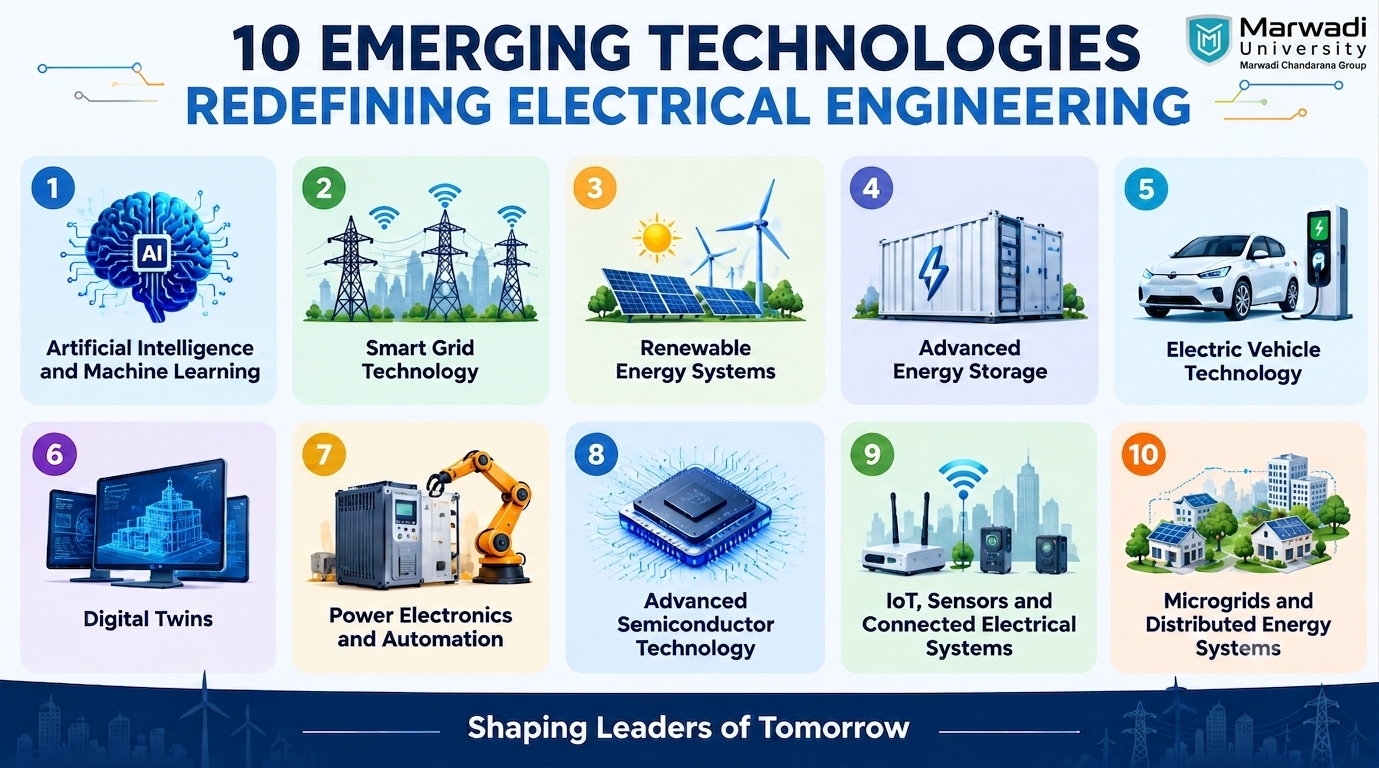
This blog explores 10 emerging technologies in electrical engineering that are redefining the field. These technologies can make energy systems smarter, cleaner, more efficient, and more connected. Whether you are pursuing a BTech in Electrical Engineering or simply exploring the field, knowing where the industry is heading can help you make better academic and career choices.
As these innovations move from laboratories into real-world applications, electrical engineers will increasingly work across disciplines. They may design intelligent systems, manage renewable power, develop high-performance electronics, or help build connected transportation networks. Understanding technology and its practical impact will become a major advantage for tomorrow’s engineers and innovators.
1. Artificial Intelligence and Machine Learning
AI is becoming a practical tool for designing, monitoring, and operating electrical systems. AI in electrical engineering can help engineers predict equipment failures, optimize energy use, detect faults, and improve system performance.
Key applications include:
- Predictive maintenance for transformers, motors, and generators
- Demand forecasting and load management
- Automated fault detection and system diagnostics
- Simulation, design optimization, and maintenance planning
Machine learning can analyze large amounts of sensor data much faster than traditional methods. For students, learning electrical fundamentals alongside data analysis, programming, and machine learning can open new career paths. AI will increasingly support engineers rather than simply replace engineering expertise.
2. Smart Grid Technology
Traditional power networks are evolving into intelligent networks that can respond to changing conditions. Smart grid technology combines sensors, communication networks, automation, and advanced control systems to make electricity distribution more reliable and efficient.
Important smart-grid features include:
- Smart meters that provide detailed energy-use information
- Automated fault detection and power rerouting
- Real-time monitoring of voltage, current, and demand
- Integration of solar power, batteries, and electric vehicles
As electricity demand becomes more dynamic, engineers will need to understand both electrical systems and digital technologies. This makes smart grids one of the most important areas in the future of electrical engineering today.
3. Renewable Energy Systems
The shift toward cleaner electricity is creating major opportunities for engineers. Renewable energy technology includes solar photovoltaic systems, wind power, advanced inverters, and other methods of generating low-carbon electricity.
Electrical engineers contribute by designing:
- Grid connections and power-conversion systems
- Renewable-energy control and protection equipment
- Solar and wind monitoring systems
- Hybrid systems combining renewable sources and storage
Unlike conventional plants, renewable sources can vary with weather and time, creating challenges for grid stability and power management. Students who understand power systems and clean-energy technologies can contribute to the global transition toward more sustainable electricity.
4. Advanced Energy Storage
As renewable generation grows, storing electricity becomes increasingly important. Energy storage technology includes lithium-ion batteries, flow batteries, thermal storage, and other solutions that can hold energy for later use.
Energy storage can help to:
- Balance variable renewable generation
- Provide backup power during outages
- Reduce peak electricity demand
- Improve grid stability and reliability
- Support electric vehicles and microgrids
Electrical engineers work on battery systems, power converters, control strategies, safety, and energy management. The field is also moving toward smarter battery monitoring and longer-lasting systems. For students, energy storage offers opportunities across utilities, renewable energy, transportation, electronics, and industrial systems.
5. Electric Vehicle Technology
Electric mobility is transforming both transportation and electricity systems. Electric vehicle technology now involves advanced batteries, fast charging, motor drives, power electronics, and intelligent energy management.
Engineers are working to improve:
- Charging speed and driving range
- Battery life, safety, and thermal management
- Motor efficiency and vehicle performance
- Charging-station design and grid integration
- Vehicle-to-grid energy exchange
The growth of EVs also creates challenges for electricity networks because many vehicles may charge simultaneously. Smart charging can help manage this demand and connect vehicles with the wider grid. Electrical engineers can contribute to vehicle design, charging infrastructure, and energy systems.
6. Digital Twins
A digital twin is a virtual representation of a physical asset or system that can be updated using real-world data. Digital twins in electrical engineering applications can model motors, transformers, substations, power plants, and entire networks.
Digital twins can support:
- Equipment-performance monitoring
- Predictive maintenance and failure analysis
- Virtual testing of system changes
- Energy-efficiency improvements
- Training and operational decision-making
Combined with sensors, simulation, and AI, digital twins can support faster and more informed decisions. This technology is especially valuable for complex infrastructure where downtime is costly. Learning simulation, data interpretation, and system modeling can help students prepare for this growing engineering approach.
7. Power Electronics and Automation
Modern electrical systems depend heavily on efficient conversion and control of electrical power. Power electronics and automation bring together semiconductor devices, converters, motor drives, sensors, controllers, and industrial automation.
These technologies are essential in:
- Electric vehicles and charging systems
- Renewable-energy converters
- Automated factories and production lines
- Data centres and smart appliances
- Industrial motor-control applications
New generations of power devices can improve efficiency and reduce energy losses, while automation enables machines to respond quickly to changing conditions. Electrical engineers increasingly need to understand both hardware and control software. This combination creates opportunities in industrial automation, energy systems, transportation, manufacturing, and advanced electronics.
8. Advanced Semiconductor Technology
Semiconductor technology is advancing beyond conventional silicon devices. Wide-bandgap materials such as silicon carbide and gallium nitride can support higher switching speeds, higher temperatures, and improved efficiency in many power applications.
Advanced semiconductors are being used in:
- EV chargers and traction inverters
- Renewable-energy conversion systems
- Data-centre power supplies
- Industrial motor drives
- Compact consumer and medical electronics
Electrical engineers help select, design, control, and integrate these components into practical products. As electrification increases, demand for efficient power conversion will also grow. Students who build strong foundations in circuits, electronics, semiconductor devices, and control systems can prepare for opportunities connected to advanced power hardware and next-generation energy technologies.
9. IoT, Sensors and Connected Electrical Systems
Modern cities and industries need electrical systems that can communicate, sense conditions, and respond automatically. The Internet of Things, advanced sensors, edge computing, and connected control systems are making electrical infrastructure more responsive.
Connected electrical systems can provide:
- Real-time monitoring of voltage, current, temperature, and vibration
- Remote equipment diagnostics
- Automated energy management
- Improved safety and maintenance planning
- Data for smart buildings, factories, and substations
As more physical infrastructure becomes connected, electrical engineers will increasingly collaborate with software and communications specialists. This convergence is one of the defining future technologies in electrical engineering today. Cybersecurity and reliable communication will also become essential parts of system design.
10. Microgrids and Distributed Energy Systems
The electricity sector is becoming more decentralized, with homes, businesses, vehicles, batteries, and renewable generators becoming active participants. Microgrids and distributed energy resources allow local areas to generate, store, and manage electricity, sometimes operating independently from the main grid.
Microgrid systems can offer:
- Greater resilience during grid disruptions
- Local integration of solar, wind, and battery storage
- Improved energy management and efficiency
- Backup power for hospitals, campuses, and industries
- Support for remote and underserved communities
Electrical engineers design protection systems, controls, converters, and energy-management strategies that make these networks reliable. As distributed generation expands, engineers will need to balance technical performance, cybersecurity, economics, and user needs.
Final Thoughts
The future of electrical engineering is being shaped by technologies that connect electricity with intelligence, sustainability, mobility, and automation. From AI-powered systems and smart grids to renewable generation, energy storage, digital twins, and advanced power devices, the field is becoming broader and more interdisciplinary.
For BTech students, fundamentals still matter, but they are not the whole picture. Skills in programming, data analysis, simulation, control systems, and emerging energy technologies can expand career options. Following trends and building practical projects can help students stay prepared. The engineers who combine fundamentals with curiosity and adaptability will be ready to shape tomorrow’s electrical world.
FAQs
1. What is the future of electrical engineering?
The future of electrical engineering will be shaped by AI, smart grids, renewable energy, energy storage, EVs, automation, advanced electronics, and connected infrastructure.
2. What are the emerging technologies in electrical engineering?
Key emerging technologies in electrical engineering include AI, smart grids, renewable energy, energy storage, digital twins, EVs, advanced semiconductors, automation, IoT, and microgrids.
3. How is AI changing electrical engineering?
AI in electrical engineering helps with predictive maintenance, fault detection, energy forecasting, system optimization, simulation, and automated decision-making.
4. Why is renewable energy important for electrical engineers?
Renewable energy technology requires electrical engineers to design power systems, grid connections, control systems, inverters, and energy-management solutions.
5. What skills will electrical engineers need in the future?
Future engineers will benefit from strong electrical fundamentals along with programming, AI, data analysis, automation, simulation, control systems, and knowledge of emerging energy technologies.